Dreamcatcher
Can and should dreams be recreated ?
*This project has been filed for a copyright with the Copyright Office of India. As a result, I’m unable to share the actual proposed details for the system at this time. Do feel free to reach out if you’d like to learn more.
Team
3 People
Type
Classroom Project
Duration
3 Months
My Role
Understanding the project area through secondary research, conducting primary research through surveys and interviews to fill in the gaps and studying technical documentation in finding a solution direction for the problem.
We're missing out !
We spend a third of our lives asleep. Yet most of our technology is designed only for our waking state.
The cool and creative thinking we do when we dream or half-wake isn't tapped into by our current gadgets.
This means that each of us loses out on the chance to employ interfaces to shape our own deeply sleep-dependent processes that help us remember things better, develop creative insights and
regulate our emotions.
Unraveling the Sleep Habits + Dreams of 13-20 Year Olds
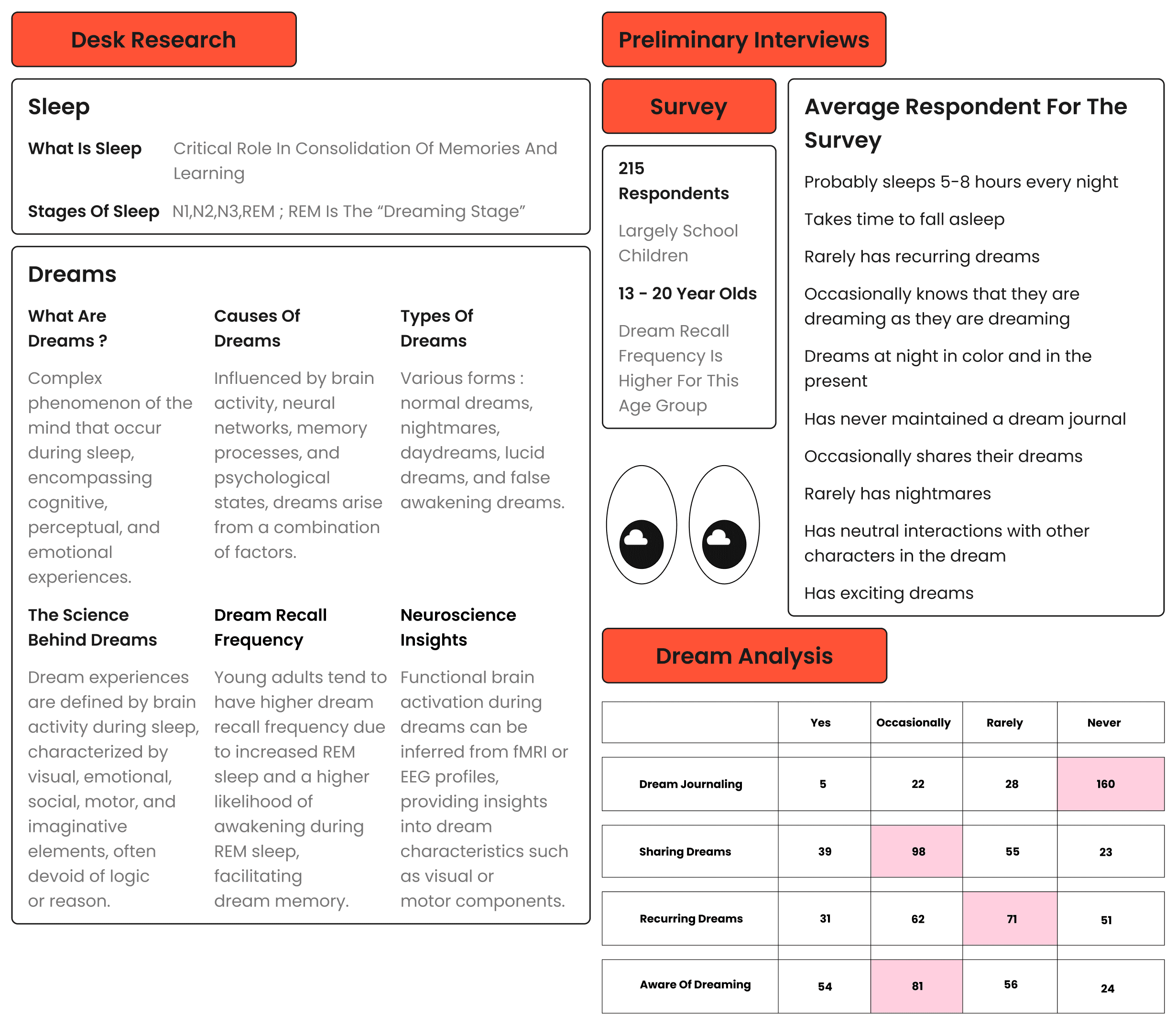
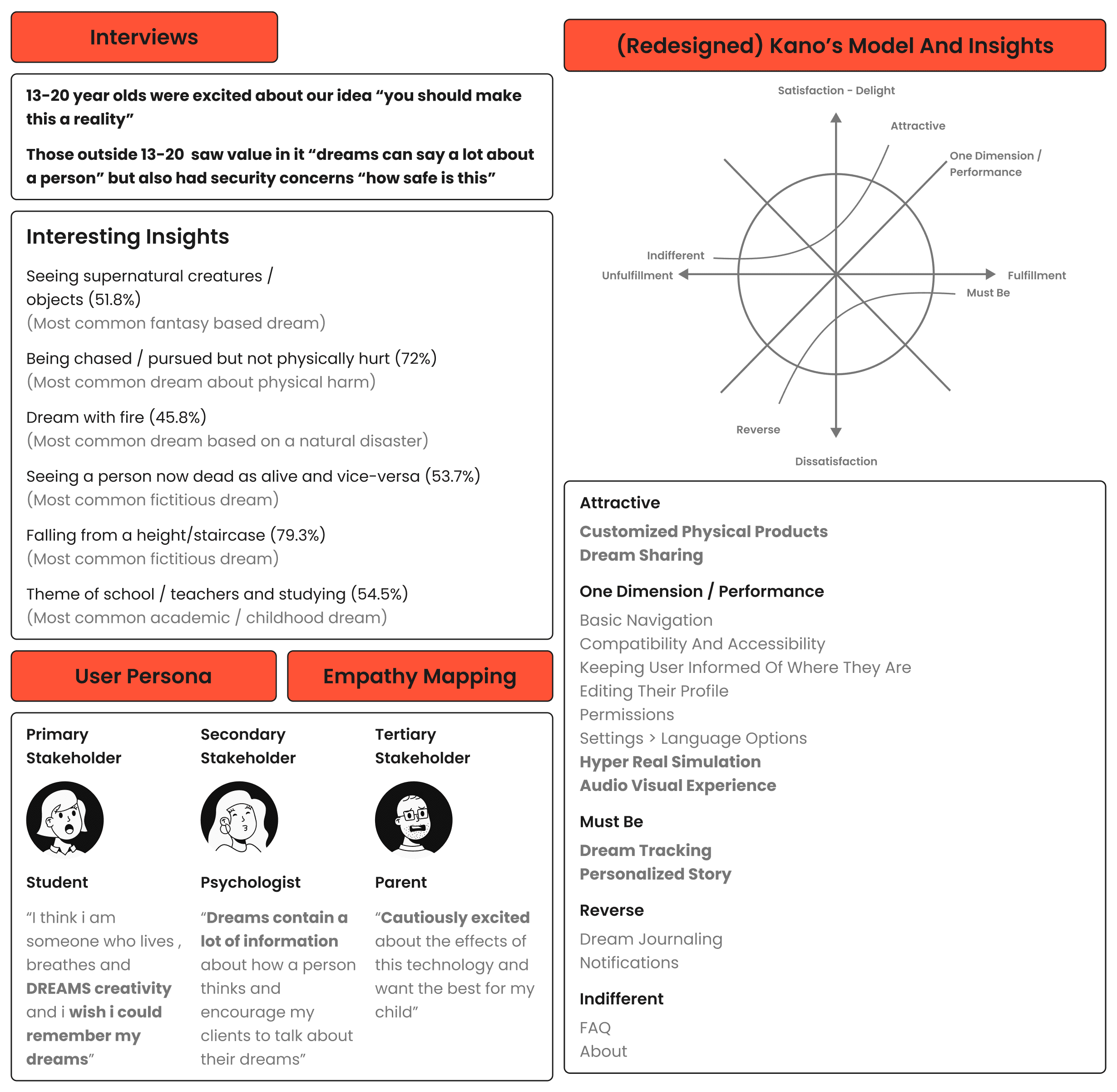
We had a blast getting to know the sleep habits and dreams of 215 students, all between 13 and 20 years old. Plus, we got to have some one-on-one "dreamy" discussions with 15 of them.
Meet Dreamcatcher
Dreamcatcher is a design intervention introduces a unique system aiming to enhance self-understanding through authentic dream recreation.
Utilizing innovative technology, dream types are identified via their electrical signatures , enhanced by dream journaling for added authenticity. Language processing, image and video algorithms offer personalized experiences, while 3D animated models amplify visual impact. The physical assembly process of the DC Headgear adds personalization.
Additionally, the process of dream review is a fundamental aspect of Image Therapy, positioning Dreamcatcher as an intervention within this psychological practice.
Dreamcatcher consists of 3 components :
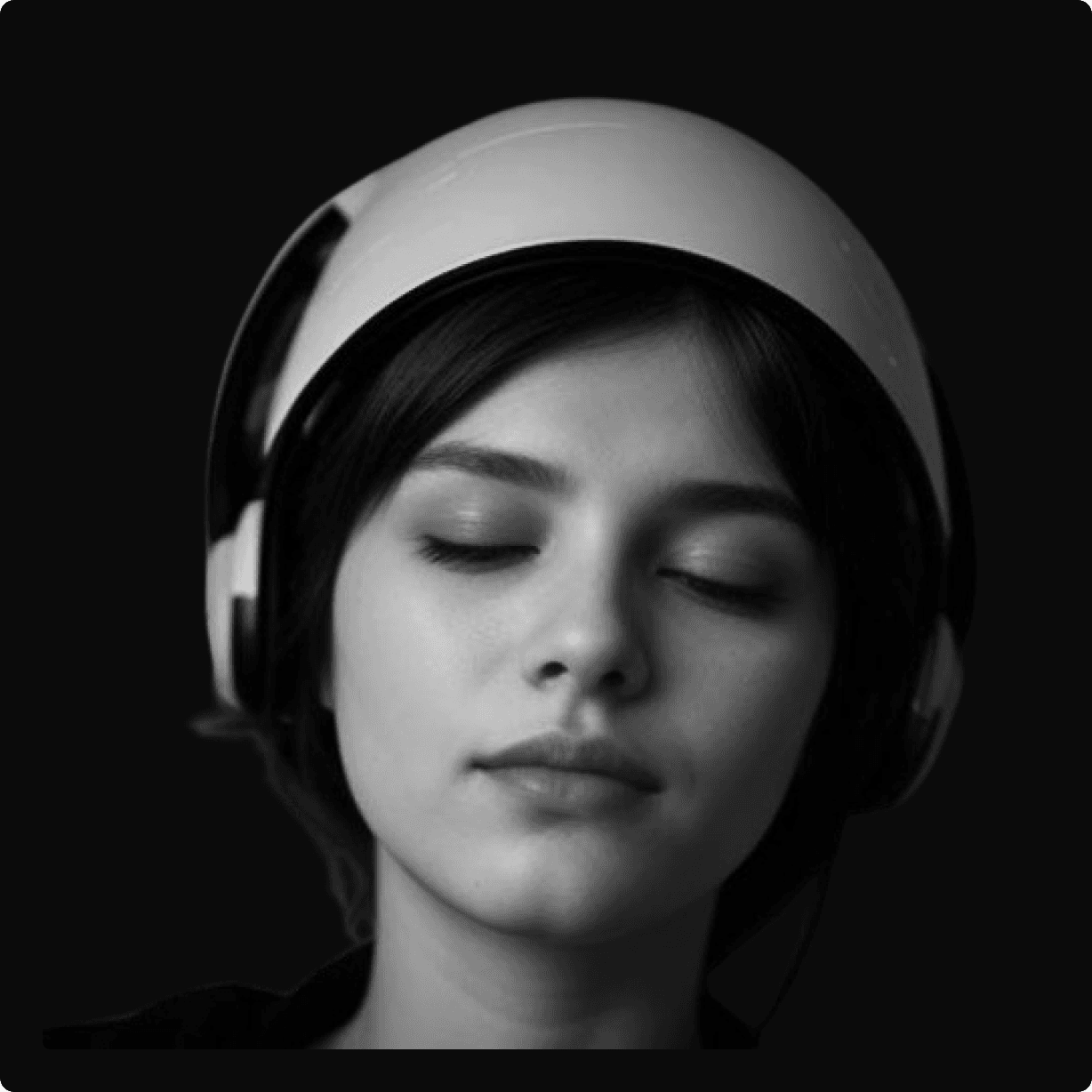
Headset with EEG sensors to record the dream that the user will wear while sleeping
Dream Data Collection
The comfortable and soft headband is specifically designed to be worn during sleep, providing a non-intrusive way to track emotions and sleep patterns.
Embedded with EEG sensors, it seamlessly monitors brain activity, allowing for the collection of valuable data.
By combining this data with the user's dream journal entries, a deeper understanding of their dreams can be achieved.
The EEG sensors inside the headband capture brainwave patterns associated with different emotional states and sleep stages.
*This image is AI-generated, and the actual proposed design may differ from what is shown here.
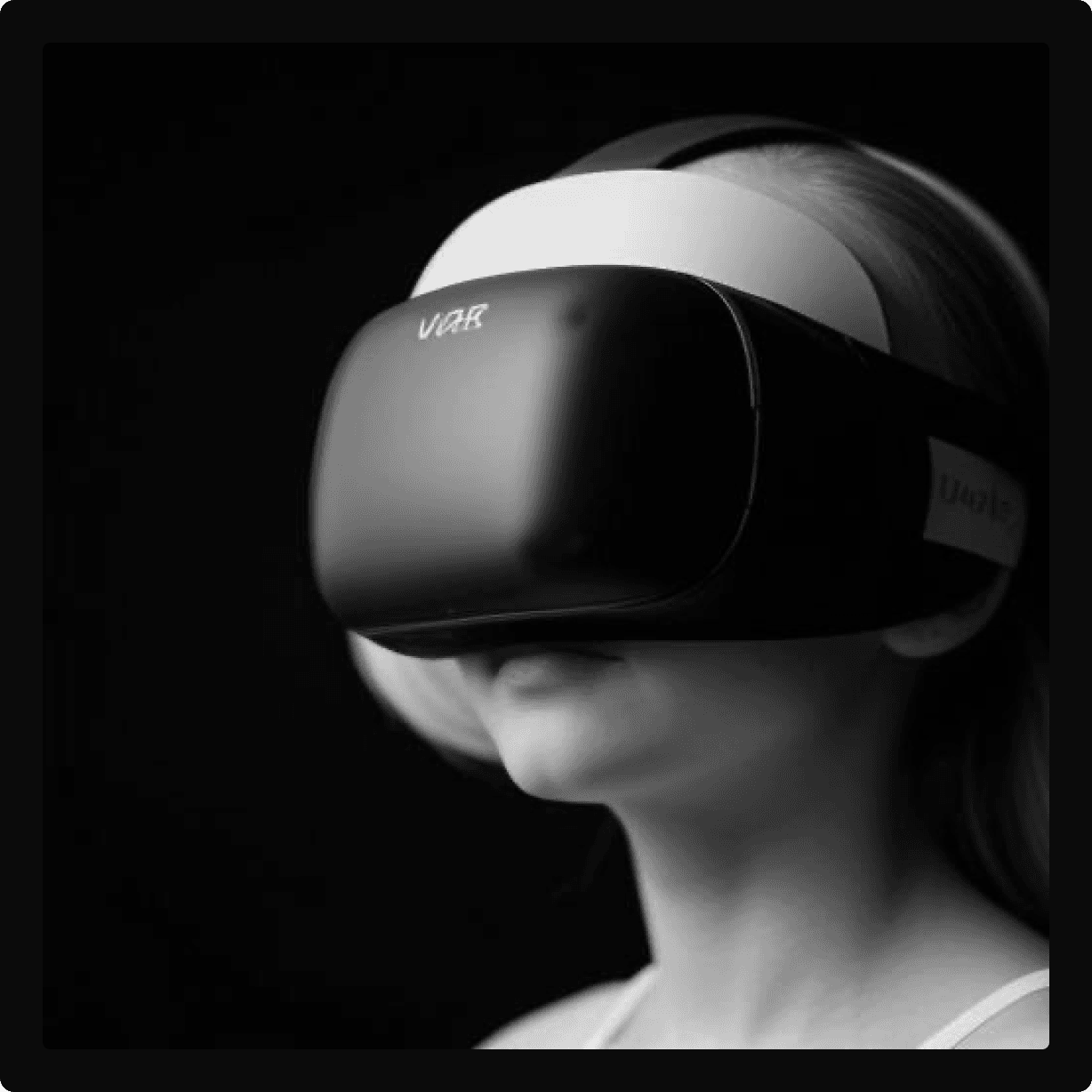
Eyepiece that the user will wear to
watch the dream
Dream Viewing
Brainwaves to text (NVIDIA) using neural signal processing, speech detection , word classification , language modeling
Text to video text input > language processing (NLP) > image and video search (CV Algorithm)> video creationVideo to 3D Input > Training > Synthesis > Output
*This image is AI-generated, and the actual proposed design may differ from what is shown here.
Mobile Application
Dream Recall Input
In this app, users can recall and expand on their dreams with the assistance of prompts designed to elicit more detailed memories.
After adding what they remember, individuals can watch their dreams unfold by placing the device in the eyepiece.
Furthermore, users have the ability to explore their past dreams and analyze patterns within them, along with accessing health statistics and other device-related information through the accompanying app.
*The actual proposed design may differ from what is
shown here.
For Details
Learnings, Challenges and Potential Impact
Learnings:
Learning about a new space - Understanding sleep science, dream science and a specific user group.
Building technology knowledge - Reading up amd grasping tech like fMRI, EEG, text-to-video, 3D Al, NLP, and CV algorithms.
User-centric design - Keeping user feedback front and center to shape design decisions.
Challenges:
Potential Emotional Sensitivity - Rewatching negative dreams can be distressing, bringing unresolved fears to the forefront.
Privacy Concerns - Dreams' intimate nature raises data security concerns. Users may feel uneasy about sharing sensitive data.
Technical Limitations - Recreating dreams fully may not be possible, causing inaccuracies in re-experiencing them.
Potential Impact:
Image Therapy - The system can integrate into image therapy. Users can re-experience dreams, helping confront emotions, process trauma, or explore subconscious thoughts.
Creative, Entertainment, Educational Applications - Dreams inspire art and films. This tech unlocks immersive experiences, allowing users to share their dreams and even support cognitive studies for young adult education.
Sleep And Mental Health - The system could monitor dream patterns to detect issues like nightmares or sleep disturbances, offering recommendations to improve mental well-being and sleep quality.
What worked and what didn't ?
While our survey provided a robust quantitative analysis of the sleep and dream patterns among Indian youths aged 13-20, it was the invaluable insights gleaned from 15 in-person interviews that truly molded our final feature list , making me wonder if investing more time on qualitative data might have been
more fruitful.
Given the evolving nature of the technological components integral to this project, the actual creation and testing of Dreamcatcher is currently unfeasible. Therefore, this project is presented as an ideation, offering a glimpse into the potential possibilities once the necessary technological advancements are realized.
For me, this project signifies a pivotal entry point into the fascinating domain of Human-Computer Interaction. I am thrilled at the prospect of delving deeper into the convergence of psychology and technology, exploring this dynamic intersection with curiosity.
Dreamcatcher
Can and should dreams be recreated ?
Team
3 People
Type
Classroom Project
Duration
3 Months
My Role
Understanding the project area through secondary research, conducting primary research through surveys and interviews to fill in the gaps and studying technical documentation in finding a solution direction for the problem.
We're missing out !
We spend a third of our lives asleep. Yet most of our technology is designed only for our waking state.
The cool and creative thinking we do when we dream or half-wake isn't tapped into by our current gadgets.
This means that each of us loses out on the chance to employ interfaces to shape our own deeply sleep-dependent processes that help us remember things better, develop creative insights and
regulate our emotions.
Unraveling the Sleep Habits + Dreams of 13-20 Year Olds
We had a blast getting to know the sleep habits and dreams of 215 students, all between 13 and 20 years old. Plus, we got to have some one-on-one "dreamy" discussions with 15 of them.
Meet Dreamcatcher
Dreamcatcher is a design intervention introduces a unique system aiming to enhance self-understanding through authentic dream recreation.
Utilizing innovative technology, dream types are identified via their electrical signatures , enhanced by dream journaling for added authenticity. Language processing, image and video algorithms offer personalized experiences, while 3D animated models amplify visual impact. The physical assembly process of the DC Headgear adds personalization.
Additionally, the process of dream review is a fundamental aspect of Image Therapy, positioning Dreamcatcher as an intervention within this psychological practice.
Dreamcatcher consists of 3 components :
Headset with EEG sensors to record the dream that the user will wear while sleeping
Dream Data Collection
The comfortable and soft headband is specifically designed to be worn during sleep, providing a non-intrusive way to track emotions and sleep patterns.
Embedded with EEG sensors, it seamlessly monitors brain activity, allowing for the collection of valuable data.
By combining this data with the user's dream journal entries, a deeper understanding of their dreams can be achieved.
The EEG sensors inside the headband capture brainwave patterns associated with different emotional states and sleep stages.
*This image is AI-generated, and the actual proposed design may differ from what is shown here.
Eyepiece that the user will wear to
watch the dream
Dream Viewing
Brainwaves to text (NVIDIA) using neural signal processing, speech detection , word classification , language modeling
Text to video text input > language processing (NLP) > image and video search (CV Algorithm)> video creationVideo to 3D Input > Training > Synthesis > Output
*This image is AI-generated, and the actual proposed design may differ from what is shown here.
Mobile Application
Dream Recall Input
In this app, users can recall and expand on their dreams with the assistance of prompts designed to elicit more detailed memories.
After adding what they remember, individuals can watch their dreams unfold by placing the device in the eyepiece.
Furthermore, users have the ability to explore their past dreams and analyze patterns within them, along with accessing health statistics and other device-related information through the accompanying app.
*The actual proposed design may differ from what is shown here.
What worked and what didn't ?
While our survey provided a robust quantitative analysis of the sleep and dream patterns among Indian youths aged 13-20, it was the invaluable insights gleaned from 15 in-person interviews that truly molded our final feature list , making me wonder if investing more time on qualitative data might have been
more fruitful.
Given the evolving nature of the technological components integral to this project, the actual creation and testing of Dreamcatcher is currently unfeasible. Therefore, this project is presented as an ideation, offering a glimpse into the potential possibilities once the necessary technological advancements are realized.
For me, this project signifies a pivotal entry point into the fascinating domain of Human-Computer Interaction. I am thrilled at the prospect of delving deeper into the convergence of psychology and technology, exploring this dynamic intersection with curiosity.
*This project has been filed for a copyright with the Copyright Office of India. As a result, I’m unable to share the actual proposed details for the system at this time. Do feel free to reach out if you’d like to learn more.
Learnings, Challenges and Potential Impact
Learnings:
Learning about a new space - Understanding sleep science, dream science and a specific user group.
Building technology knowledge - Reading up amd grasping tech like fMRI, EEG, text-to-video, 3D Al, NLP, and CV algorithms.
User-centric design - Keeping user feedback front and center to shape design decisions.
Challenges:
Potential Emotional Sensitivity - Rewatching negative dreams can be distressing, bringing unresolved fears to the forefront.
Privacy Concerns - Dreams' intimate nature raises data security concerns. Users may feel uneasy about sharing sensitive data.
Technical Limitations - Recreating dreams fully may not be possible, causing inaccuracies in re-experiencing them.
Potential Impact:
Image Therapy - The system can integrate into image therapy. Users can re-experience dreams, helping confront emotions, process trauma, or explore subconscious thoughts.
Creative, Entertainment, Educational Applications - Dreams inspire art and films. This tech unlocks immersive experiences, allowing users to share their dreams and even support cognitive studies for young adult education.
Sleep And Mental Health - The system could monitor dream patterns to detect issues like nightmares or sleep disturbances, offering recommendations to improve mental well-being and sleep quality.
Dreamcatcher
Can and should dreams be recreated ?
Team
3 People
Type
Classroom Project
Duration
3 Months
My Role
Understanding the project area through secondary research, conducting primary research through surveys and interviews to fill in the gaps and studying technical documentation in finding a solution direction for the problem.
We're missing out !
We spend a third of our lives asleep. Yet most of our technology is designed only for our
waking state.
The cool and creative thinking we do when we dream or half-wake isn't tapped into by our
current gadgets.
This means that each of us loses out on the chance to employ interfaces to shape our own deeply sleep-dependent processes that help us remember things better, develop creative insights and
regulate our emotions.
Unraveling the Sleep Habits + Dreams of 13-20 Year Olds
We had a blast getting to know the sleep habits and dreams of 215 students, all between 13 and 20 years old. Plus, we got to have some one-on-one "dreamy" discussions with 15 of them.
Meet Dreamcatcher
Dreamcatcher is a design intervention introduces a unique system aiming to enhance self-understanding through authentic dream recreation.
Utilizing innovative technology, dream types are identified via their electrical signatures , enhanced by dream journaling for added authenticity. Language processing, image and video algorithms offer personalized experiences, while 3D animated models amplify visual impact. The physical assembly process of the DC Headgear adds personalization.
Additionally, the process of dream review is a fundamental aspect of Image Therapy, positioning Dreamcatcher as an intervention within this psychological practice.
Dreamcatcher consists of 3 components :
Headset with EEG sensors to record the dream that the user will wear while sleeping
Dream Data Collection
The comfortable and soft headband is specifically designed to be worn during sleep, providing a non-intrusive way to track emotions and sleep patterns.
Embedded with EEG sensors, it seamlessly monitors brain activity, allowing for the collection of valuable data.
By combining this data with the user's dream journal entries, a deeper understanding of their dreams can be achieved.
The EEG sensors inside the headband capture brainwave patterns associated with different emotional states and sleep stages.
*This image is AI-generated, and the actual proposed design may differ from what is shown here.
Eyepiece that the user will wear to
watch the dream
Dream Viewing
Brainwaves to text (NVIDIA) using neural signal processing, speech detection , word classification , language modeling
Text to video text input > language processing (NLP) > image and video search (CV Algorithm)> video creationVideo to 3D Input > Training > Synthesis > Output
*This image is AI-generated, and the actual proposed design may differ from what is shown here.
Mobile Application
Dream Recall Input
In this app, users can recall and expand on their dreams with the assistance of prompts designed to elicit more detailed memories.
After adding what they remember, individuals can watch their dreams unfold by placing the device in the eyepiece.
Furthermore, users have the ability to explore their past dreams and analyze patterns within them, along with accessing health statistics and other device-related information through the accompanying app.
*The actual proposed design may differ from what is shown here.
*This project has been filed for a copyright with the Copyright Office of India. As a result, I’m unable to share the actual proposed details for the system at this time. Do feel free to reach out if you’d like to learn more.
Learnings, Challenges and Potential Impact
Learnings:
Learning about a new space - Understanding sleep science, dream science and a specific user group.
Building technology knowledge - Reading up amd grasping tech like fMRI, EEG, text-to-video, 3D Al, NLP, and CV algorithms.
User-centric design - Keeping user feedback front and center to shape design decisions.
Challenges:
Potential Emotional Sensitivity - Rewatching negative dreams can be distressing, bringing unresolved fears to the forefront.
Privacy Concerns - Dreams' intimate nature raises data security concerns. Users may feel uneasy about sharing sensitive data.
Technical Limitations - Recreating dreams fully may not be possible, causing inaccuracies in re-experiencing them.
Potential Impact:
Image Therapy - The system can integrate into image therapy. Users can re-experience dreams, helping confront emotions, process trauma, or explore subconscious thoughts.
Creative, Entertainment, Educational Applications - Dreams inspire art and films. This tech unlocks immersive experiences, allowing users to share their dreams and even support cognitive studies for young adult education.
Sleep And Mental Health - The system could monitor dream patterns to detect issues like nightmares or sleep disturbances, offering recommendations to improve mental well-being and sleep quality.
What worked and what didn't ?
While our survey provided a robust quantitative analysis of the sleep and dream patterns among Indian youths aged 13-20, it was the invaluable insights gleaned from 15 in-person interviews that truly molded our final feature list , making me wonder if investing more time on qualitative data might have been
more fruitful.
Given the evolving nature of the technological components integral to this project, the actual creation and testing of Dreamcatcher is currently unfeasible. Therefore, this project is presented as an ideation, offering a glimpse into the potential possibilities once the necessary technological advancements are realized.
For me, this project signifies a pivotal entry point into the fascinating domain of Human-Computer Interaction. I am thrilled at the prospect of delving deeper into the convergence of psychology and technology, exploring this dynamic intersection with curiosity.
Dreamcatcher
Can and should dreams be recreated ?
Team
3 People
Type
Classroom Project
Duration
3 Months
My Role
Understanding the project area through secondary research, conducting primary research through surveys and interviews to fill in the gaps and studying technical documentation in finding a solution direction for the problem.
We're missing out !
We spend a third of our lives asleep. Yet most of our technology is designed only for our
waking state.
The cool and creative thinking we do when we dream or half-wake isn't tapped into by our
current gadgets.
This means that each of us loses out on the chance to employ interfaces to shape our own deeply sleep-dependent processes that help us remember things better, develop creative insights and regulate our emotions.
Unraveling the Sleep Habits + Dreams of 13-20 Year Olds
We had a blast getting to know the sleep habits and dreams of 215 students, all between 13 and 20 years old. Plus, we got to have some one-on-one "dreamy" discussions with 15 of them.
Meet Dreamcatcher
Dreamcatcher is a design intervention introduces a unique system aiming to enhance self-understanding through authentic dream recreation.
Utilizing innovative technology, dream types are identified via their electrical signatures , enhanced by dream journaling for added authenticity. Language processing, image and video algorithms offer personalized experiences, while 3D animated models amplify visual impact. The physical assembly process of the DC Headgear adds personalization.
Additionally, the process of dream review is a fundamental aspect of Image Therapy, positioning Dreamcatcher as an intervention within this psychological practice.
Dreamcatcher consists of 3 components :
Headset with EEG sensors to record the dream that the user will wear while sleeping
Dream Data Collection
The comfortable and soft headband is specifically designed to be worn during sleep, providing a non-intrusive way to track emotions and sleep patterns.
Embedded with EEG sensors, it seamlessly monitors brain activity, allowing for the collection of valuable data.
By combining this data with the user's dream journal entries, a deeper understanding of their dreams can be achieved.
The EEG sensors inside the headband capture brainwave patterns associated with different emotional states and sleep stages.
*This image is AI-generated, and the actual proposed design may differ from what is shown here.
Eyepiece that the user will wear to
watch the dream
Dream Viewing
Brainwaves to text (NVIDIA) using neural signal processing, speech detection , word classification , language modeling
Text to video text input > language processing (NLP) > image and video search (CV Algorithm)> video creationVideo to 3D Input > Training > Synthesis > Output
*This image is AI-generated, and the actual proposed design may differ from what is shown here.
Mobile Application
Dream Recall Input
In this app, users can recall and expand on their dreams with the assistance of prompts designed to elicit more detailed memories.
After adding what they remember, individuals can watch their dreams unfold by placing the device in the eyepiece.
Furthermore, users have the ability to explore their past dreams and analyze patterns within them, along with accessing health statistics and other device-related information through the accompanying app.
*The actual proposed design may differ from what is shown here.
Understanding Who To Building For + Their Preferences
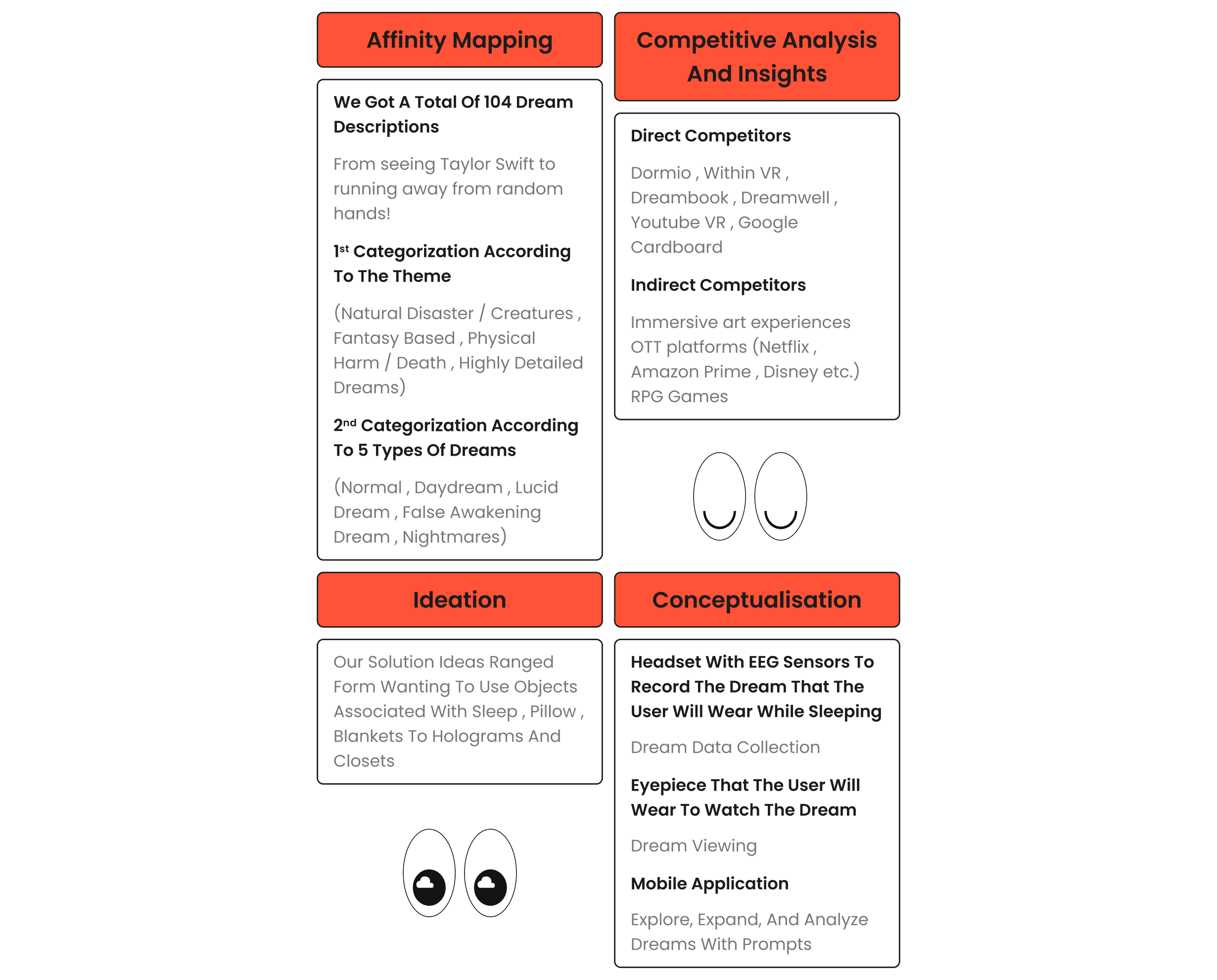
What Already Exists + What To Build
Learnings, Challenges and Potential Impact
Learnings:
Learning about a new space - Understanding sleep science, dream science and a specific user group.
Building technology knowledge - Reading up amd grasping tech like fMRI, EEG, text-to-video, 3D Al, NLP, and CV algorithms.
User-centric design - Keeping user feedback front and center to shape design decisions.
Challenges:
Potential Emotional Sensitivity - Rewatching negative dreams can be distressing, bringing unresolved fears to the forefront.
Privacy Concerns - Dreams' intimate nature raises data security concerns. Users may feel uneasy about sharing sensitive data.
Technical Limitations - Recreating dreams fully may not be possible, causing inaccuracies in re-experiencing them.
Potential Impact:
Image Therapy - The system can integrate into image therapy. Users can re-experience dreams, helping confront emotions, process trauma, or explore subconscious thoughts.
Creative, Entertainment, Educational Applications - Dreams inspire art and films. This tech unlocks immersive experiences, allowing users to share their dreams and even support cognitive studies for young adult education.
Sleep And Mental Health - The system could monitor dream patterns to detect issues like nightmares or sleep disturbances, offering recommendations to improve mental well-being and sleep quality.
What worked and what didn't ?
While our survey provided a robust quantitative analysis of the sleep and dream patterns among Indian youths aged 13-20, it was the invaluable insights gleaned from 15 in-person interviews that truly molded our final feature list , making me wonder if investing more time on qualitative data might have been more fruitful.
Given the evolving nature of the technological components integral to this project, the actual creation and testing of Dreamcatcher is currently unfeasible. Therefore, this project is presented as an ideation, offering a glimpse into the potential possibilities once the necessary technological advancements are realized.
For me, this project signifies a pivotal entry point into the fascinating domain of Human-Computer Interaction. I am thrilled at the prospect of delving deeper into the convergence of psychology and technology, exploring this dynamic intersection with curiosity.
*This project has been filed for a copyright with the Copyright Office of India. As a result, I’m unable to share the actual proposed details for the system at this time. Do feel free to reach out if you’d like to learn more.
Dreamcatcher
Can and should dreams be recreated ?
Team
3 People
Type
Classroom Project
Duration
3 Months
My Role
Understanding the project area through secondary research, conducting primary research through surveys and interviews to fill in the gaps and studying technical documentation in finding a solution direction for the problem.
We're missing out !
We spend a third of our lives asleep. Yet most of our technology is designed only for our waking state.
The cool and creative thinking we do when we dream or half-wake isn't tapped into by our
current gadgets.
This means that each of us loses out on the chance to employ interfaces to shape our own deeply sleep-dependent processes that help us remember things better, develop creative insights and
regulate our emotions.
Unraveling the Sleep Habits + Dreams of 13-20 Year Olds
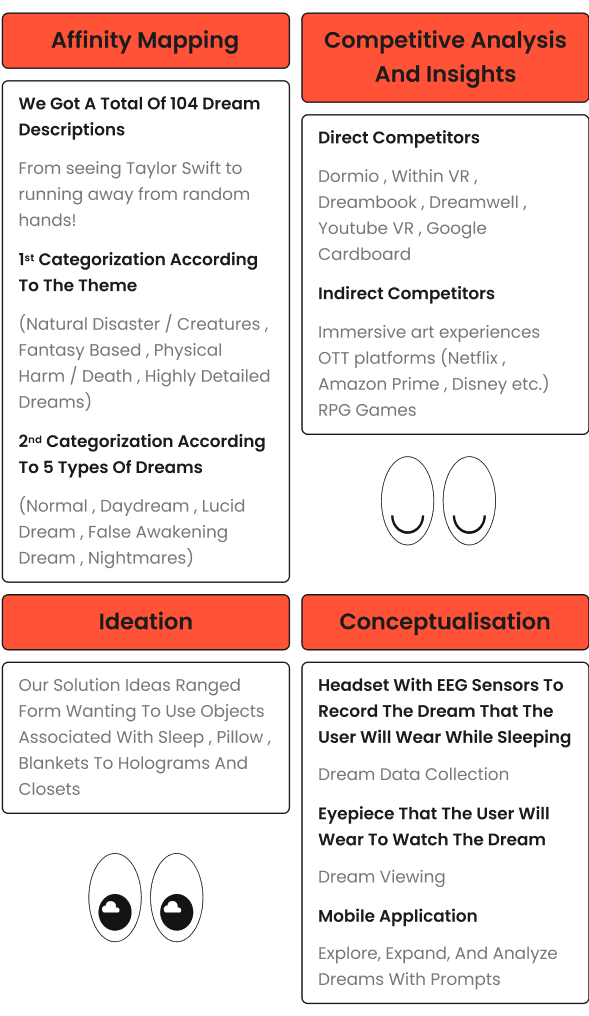
We had a blast getting to know the sleep habits and dreams of 215 students, all between 13 and 20 years old. Plus, we got to have some one-on-one "dreamy" discussions with 15 of them.
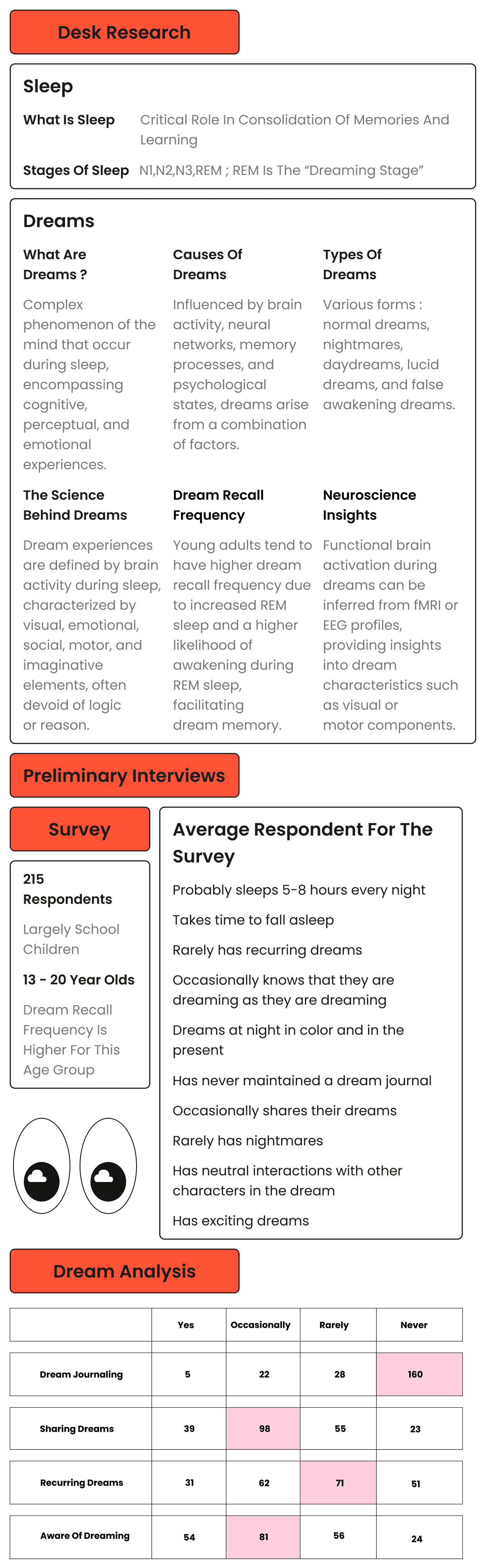
Understanding Who To Building For + Their Preferences
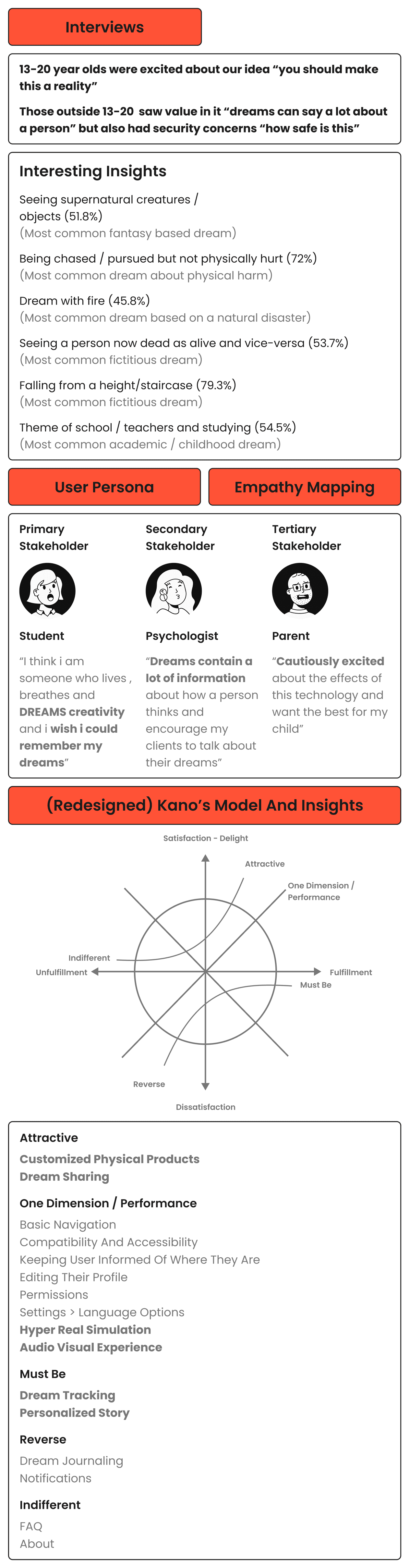
What Already Exists +
What To Build
Meet Dreamcatcher
Dreamcatcher is a design intervention introduces a unique system aiming to enhance self-understanding through authentic dream recreation.
Utilizing innovative technology, dream types are identified via their electrical signatures , enhanced by dream journaling for added authenticity. Language processing, image and video algorithms offer personalized experiences, while 3D animated models amplify visual impact. The physical assembly process of the DC Headgear adds personalization.
Additionally, the process of dream review is a fundamental aspect of Image Therapy, positioning Dreamcatcher as an intervention within this psychological practice.
Dreamcatcher consists of 3 components :
Headset with EEG sensors to record the dream that the user will wear while sleeping
Dream Data Collection
The comfortable and soft headband is specifically designed to be worn during sleep, providing a non-intrusive way to track emotions and sleep patterns.
Embedded with EEG sensors, it seamlessly monitors brain activity, allowing for the collection of valuable data.
By combining this data with the user's dream journal entries, a deeper understanding of their dreams can be achieved.
The EEG sensors inside the headband capture brainwave patterns associated with different emotional states and sleep stages.
*This image is AI-generated, and the actual proposed design may differ from what is shown here.
Eyepiece that the user will wear to
watch the dream
Dream Viewing
Brainwaves to text (NVIDIA) using neural signal processing, speech detection , word classification , language modeling
Text to video text input > language processing (NLP) > image and video search (CV Algorithm)> video creationVideo to 3D Input > Training > Synthesis > Output
*This image is AI-generated, and the actual proposed design may differ from what is shown here.
Mobile Application
Dream Recall Input
In this app, users can recall and expand on their dreams with the assistance of prompts designed to elicit more detailed memories.
After adding what they remember, individuals can watch their dreams unfold by placing the device in the eyepiece.
Furthermore, users have the ability to explore their past dreams and analyze patterns within them, along with accessing health statistics and other device-related information through the accompanying app.
*This image is AI-generated, and the actual proposed design may differ from what is shown here.
Learnings, Challenges and Potential Impact
Learnings:
Learning about a new space - Understanding sleep science, dream science and a specific user group.
Building technology knowledge - Reading up amd grasping tech like fMRI, EEG, text-to-video, 3D Al, NLP, and CV algorithms.
User-centric design - Keeping user feedback front and center to shape design decisions.
Challenges:
Potential Emotional Sensitivity - Rewatching negative dreams can be distressing, bringing unresolved fears to the forefront.
Privacy Concerns - Dreams' intimate nature raises data security concerns. Users may feel uneasy about sharing sensitive data.
Technical Limitations - Recreating dreams fully may not be possible, causing inaccuracies in re-experiencing them.
Potential Impact:
Image Therapy - The system can integrate into image therapy. Users can re-experience dreams, helping confront emotions, process trauma, or explore subconscious thoughts.
Creative, Entertainment, Educational Applications - Dreams inspire art and films. This tech unlocks immersive experiences, allowing users to share their dreams and even support cognitive studies for young adult education.
Sleep And Mental Health - The system could monitor dream patterns to detect issues like nightmares or sleep disturbances, offering recommendations to improve mental well-being and sleep quality.
What worked and
what didn't ?
While our survey provided a robust quantitative analysis of the sleep and dream patterns among Indian youths aged 13-20, it was the invaluable insights gleaned from 15 in-person interviews that truly molded our final feature list , making me wonder if investing more time on qualitative data might have been more fruitful.
Given the evolving nature of the technological components integral to this project, the actual creation and testing of Dreamcatcher is currently unfeasible. Therefore, this project is presented as an ideation, offering a glimpse into the potential possibilities once the necessary technological advancements are realized.
For me, this project signifies a pivotal entry point into the fascinating domain of Human-Computer Interaction. I am thrilled at the prospect of delving deeper into the convergence of psychology and technology, exploring this dynamic intersection
with curiosity.
*This project has been filed for a copyright with the Copyright Office of India. As a result, I’m unable to share the actual proposed details for the system at this time. Do feel free to reach out if you’d like to learn more.
Dreamcatcher
Can and should dreams be recreated ?
Team
3 People
Project Type
Classroom Project
Duration
3 Months
My Role
Understanding the project area through secondary research, conducting primary research through surveys and interviews to fill in the gaps and studying technical documentation in finding a solution direction for the problem.
We're missing out !
We spend a third of our lives asleep. Yet most of our technology is designed only for our waking state.
The cool and creative thinking we do when we dream or half-wake isn't tapped into by our current gadgets.
This means that each of us loses out on the chance to employ interfaces to shape our own deeply sleep-dependent processes that help us remember things better, develop creative insights and regulate our emotions.
Unraveling the Sleep Habits + Dreams of 13-20 Year Olds
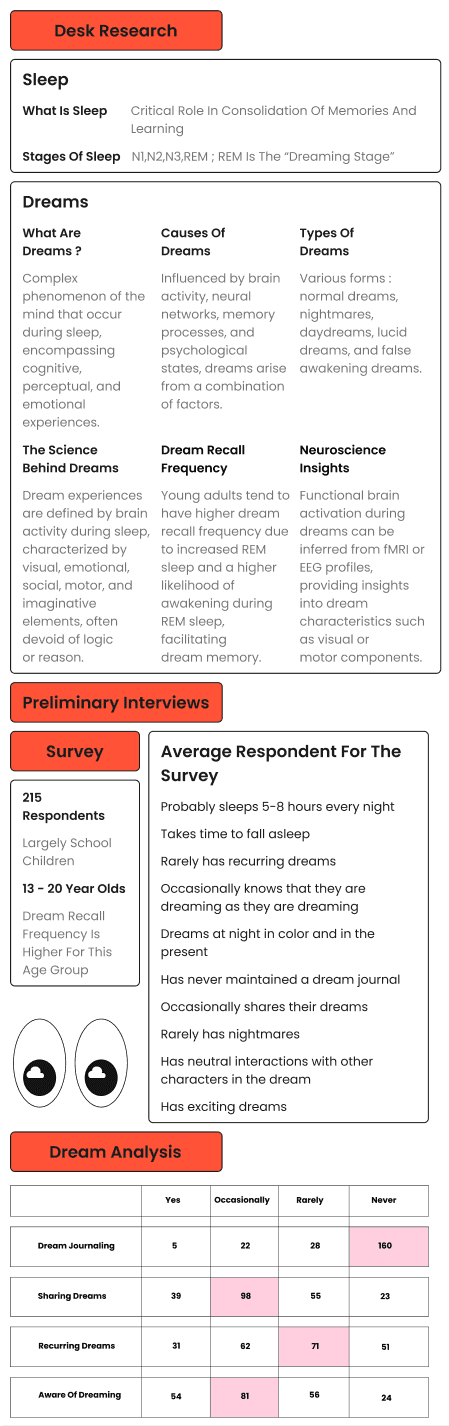
We had a blast getting to know the sleep habits and dreams of 215 students, all between 13 and 20 years old. Plus, we got to have some one-on-one "dreamy" discussions with 15 of them.
Meet Dreamcatcher
Dreamcatcher is a design intervention introduces a unique system aiming to enhance self-understanding through authentic dream recreation.
Utilizing innovative technology, dream types are identified via their electrical signatures , enhanced by dream journaling for added authenticity. Language processing, image and video algorithms offer personalized experiences, while 3D animated models amplify visual impact. The physical assembly process of the DC Headgear adds personalization.
Additionally, the process of dream review is a fundamental aspect of Image Therapy, positioning Dreamcatcher as an intervention within this psychological practice.
Dreamcatcher consists of
3 components :
Headset with EEG sensors to record the dream that the user will wear while sleeping
Dream Data Collection
The comfortable and soft headband is specifically designed to be worn during sleep, providing a non-intrusive way to track emotions and sleep patterns.
Embedded with EEG sensors, it seamlessly monitors brain activity, allowing for the collection of valuable data.
By combining this data with the user's dream journal entries, a deeper understanding of their dreams can be achieved.
The EEG sensors inside the headband capture brainwave patterns associated with different emotional states and sleep stages.
*This image is AI-generated, and the actual proposed design may differ from what is shown here.
Eyepiece that the user will wear to watch the dream
Dream Viewing
Brainwaves to text (NVIDIA) using neural signal processing, speech detection , word classification , language modeling
Text to video text input > language processing (NLP) > image and video search (CV Algorithm)> video creationVideo to 3D Input > Training > Synthesis > Output
*This image is AI-generated, and the actual proposed design may differ from what is shown here.
Mobile Application
Dream Recall Input
In this app, users can recall and expand on their dreams with the assistance of prompts designed to elicit more detailed memories.
After adding what they remember, individuals can watch their dreams unfold by placing the device in the eyepiece.
Furthermore, users have the ability to explore their past dreams and analyze patterns within them, along with accessing health statistics and other device-related information through the accompanying app.
*This image is AI-generated, and the actual proposed design may differ from what is shown here.
Understanding Who To Building For + Their Preferences
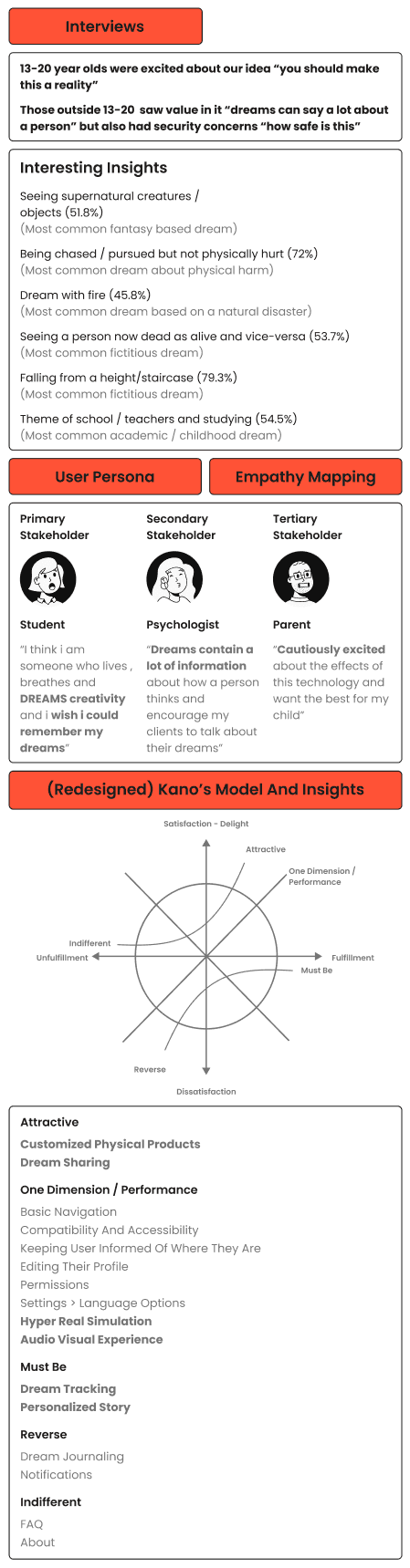
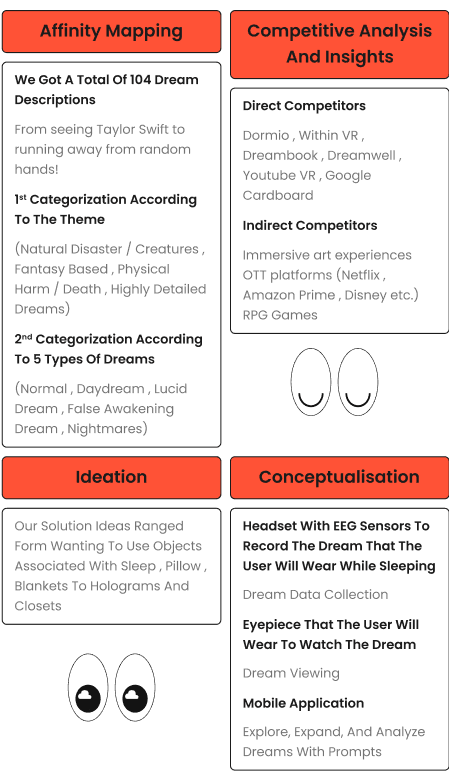
What Already Exists +
What To Build
Learnings, Challenges and Potential Impact
Learnings:
Learning about a new space - Understanding sleep science, dream science and a specific user group.
Building technology knowledge - Reading up amd grasping tech like fMRI, EEG, text-to-video, 3D Al, NLP, and CV algorithms.
User-centric design - Keeping user feedback front and center to shape design decisions.
Challenges:
Potential Emotional Sensitivity - Rewatching negative dreams can be distressing, bringing unresolved fears to the forefront.
Privacy Concerns - Dreams' intimate nature raises data security concerns. Users may feel uneasy about sharing sensitive data.
Technical Limitations - Recreating dreams fully may not be possible, causing inaccuracies in re-experiencing them.
Potential Impact:
Image Therapy - The system can integrate into image therapy. Users can re-experience dreams, helping confront emotions, process trauma, or explore subconscious thoughts.
Creative, Entertainment, Educational Applications - Dreams inspire art and films. This tech unlocks immersive experiences, allowing users to share their dreams and even support cognitive studies for young adult education.
Sleep And Mental Health - The system could monitor dream patterns to detect issues like nightmares or sleep disturbances, offering recommendations to improve mental well-being and sleep quality.
What worked and
what didn't ?
While our survey provided a robust quantitative analysis of the sleep and dream patterns among Indian youths aged 13-20, it was the invaluable insights gleaned from 15 in-person interviews that truly molded our final feature list , making me wonder if investing more time on qualitative data might have been more fruitful.
Given the evolving nature of the technological components integral to this project, the actual creation and testing of Dreamcatcher is currently unfeasible. Therefore, this project is presented as an ideation, offering a glimpse into the potential possibilities once the necessary technological advancements are realized.
For me, this project signifies a pivotal entry point into the fascinating domain of Human-Computer Interaction. I am thrilled at the prospect of delving deeper into the convergence of psychology and technology, exploring this dynamic intersection
with curiosity.
*This project has been filed for a copyright with the Copyright Office of India. As a result, I’m unable to share the actual proposed details for the system at this time. Do feel free to reach out if you’d like to learn more.