TwoDots
Designing for monetization while balancing player
engagement for a sustainable experience in mobile games.
*This project is under NDA and has be adapted to be showcased as this study.
Team
Core Pre - Prod Team (4) People
1 PM, 1 Game Designer, 1 Artist and me as the UX Designer
Functions: Total 8;
Product, Game Design, Producer, QA / Tester, Software
Engineering, Art, Tech Art/ Animation and UX Design
Pod structure, meaning close collaboration with all functions.
Type
Internship
Duration
6 Months
My Role
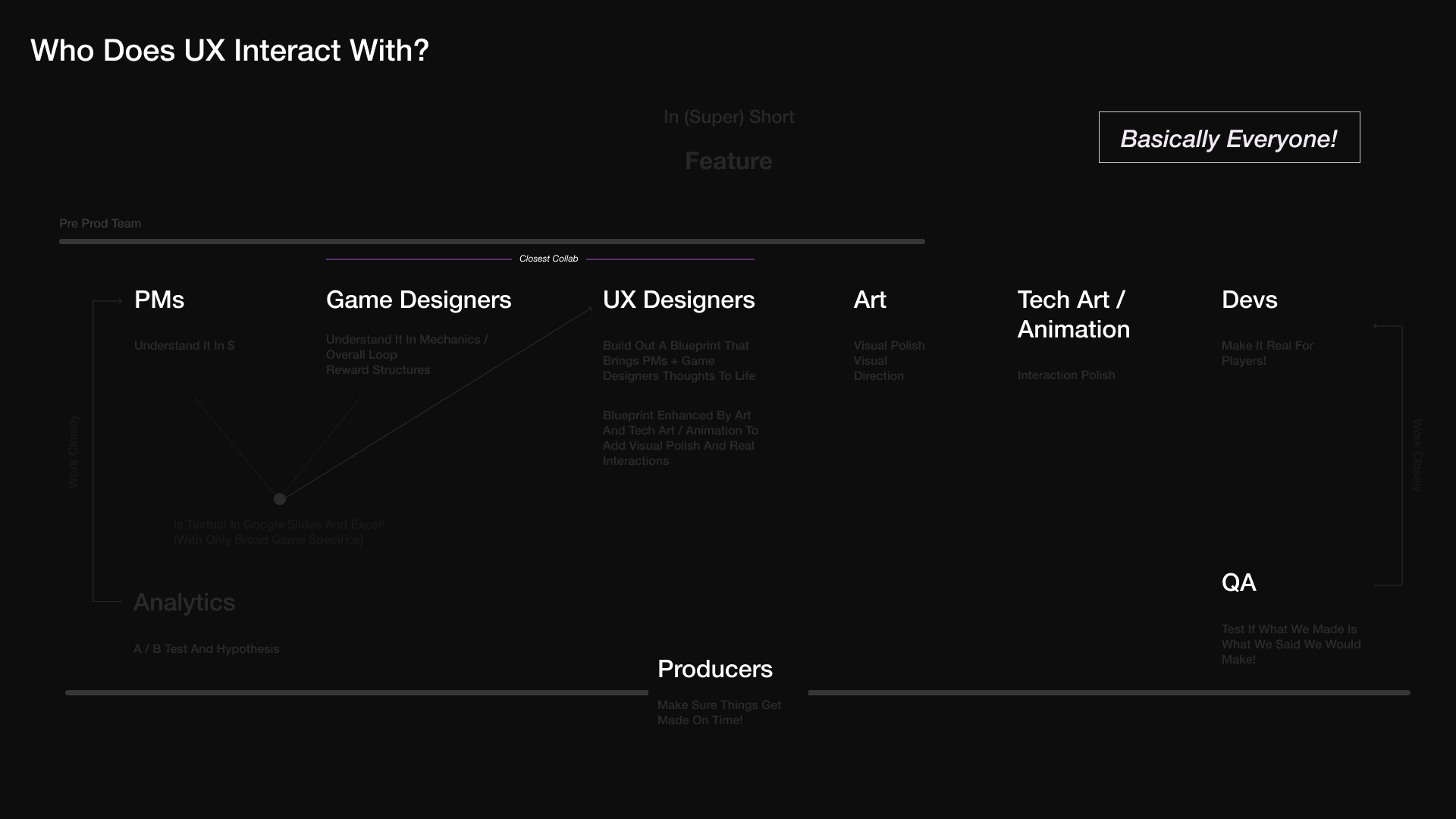
Sole UX Designer in India pod for a live mobile game, managing end-to-end design in collaboration with global teams and stakeholders.
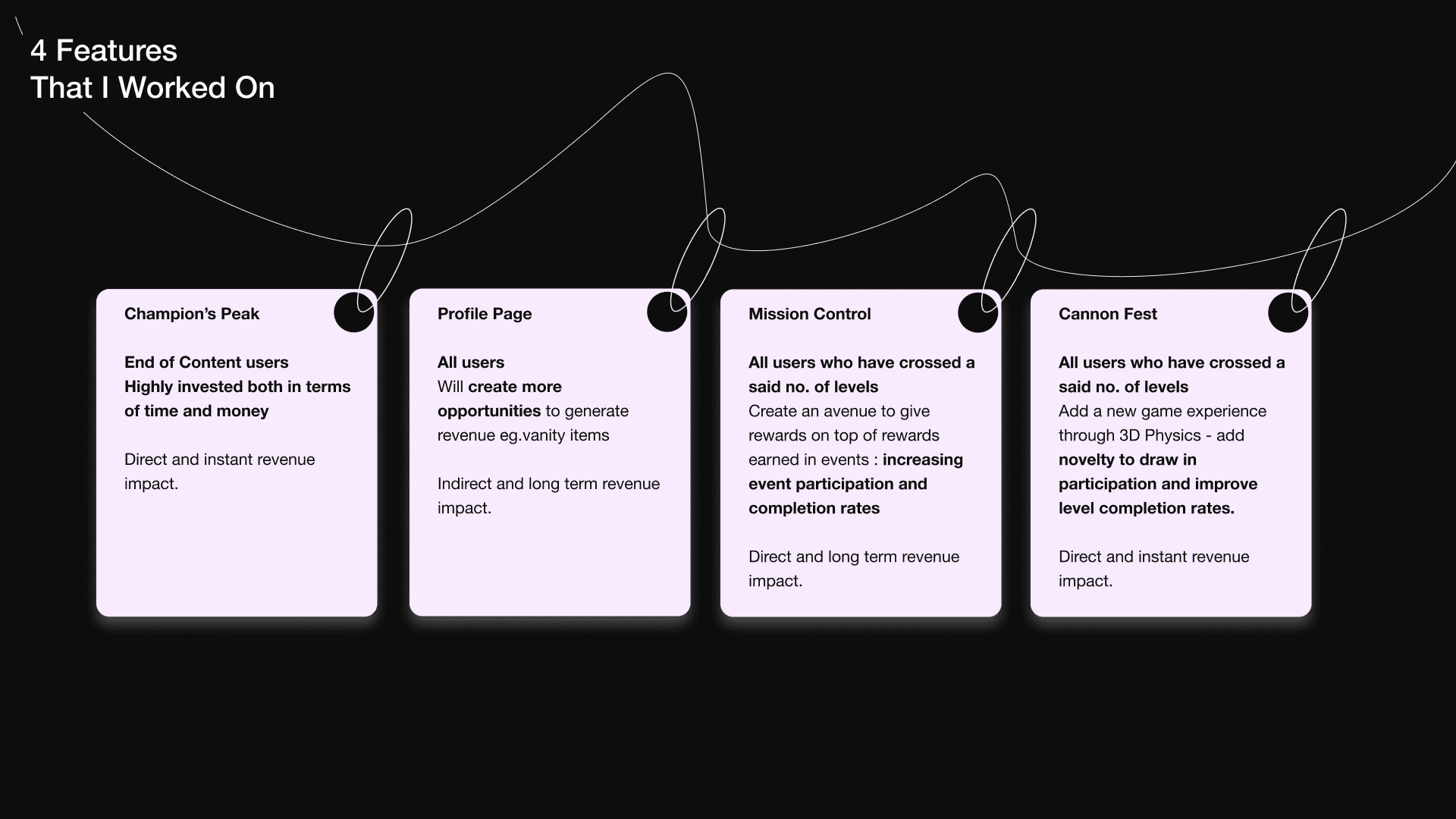
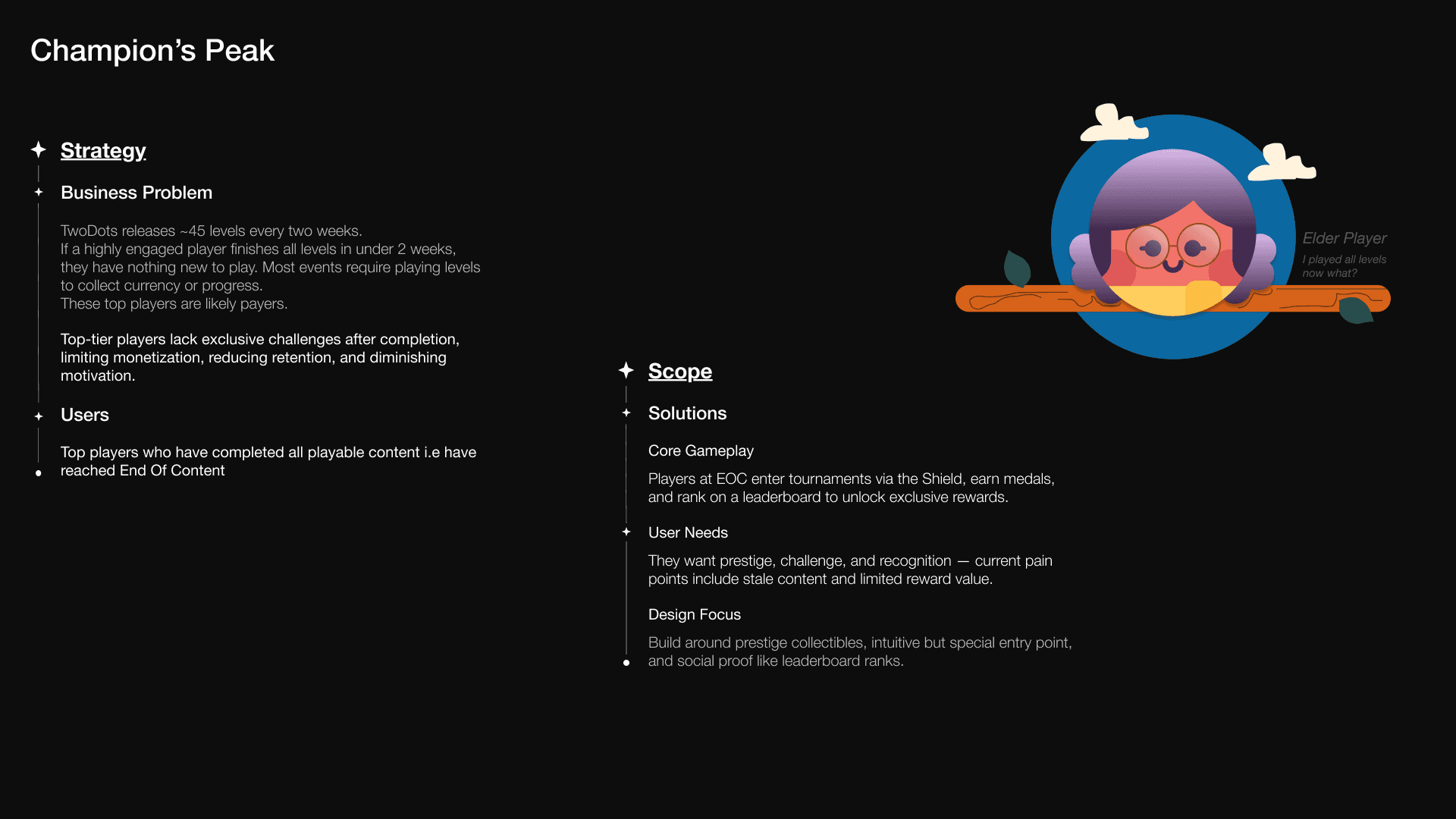
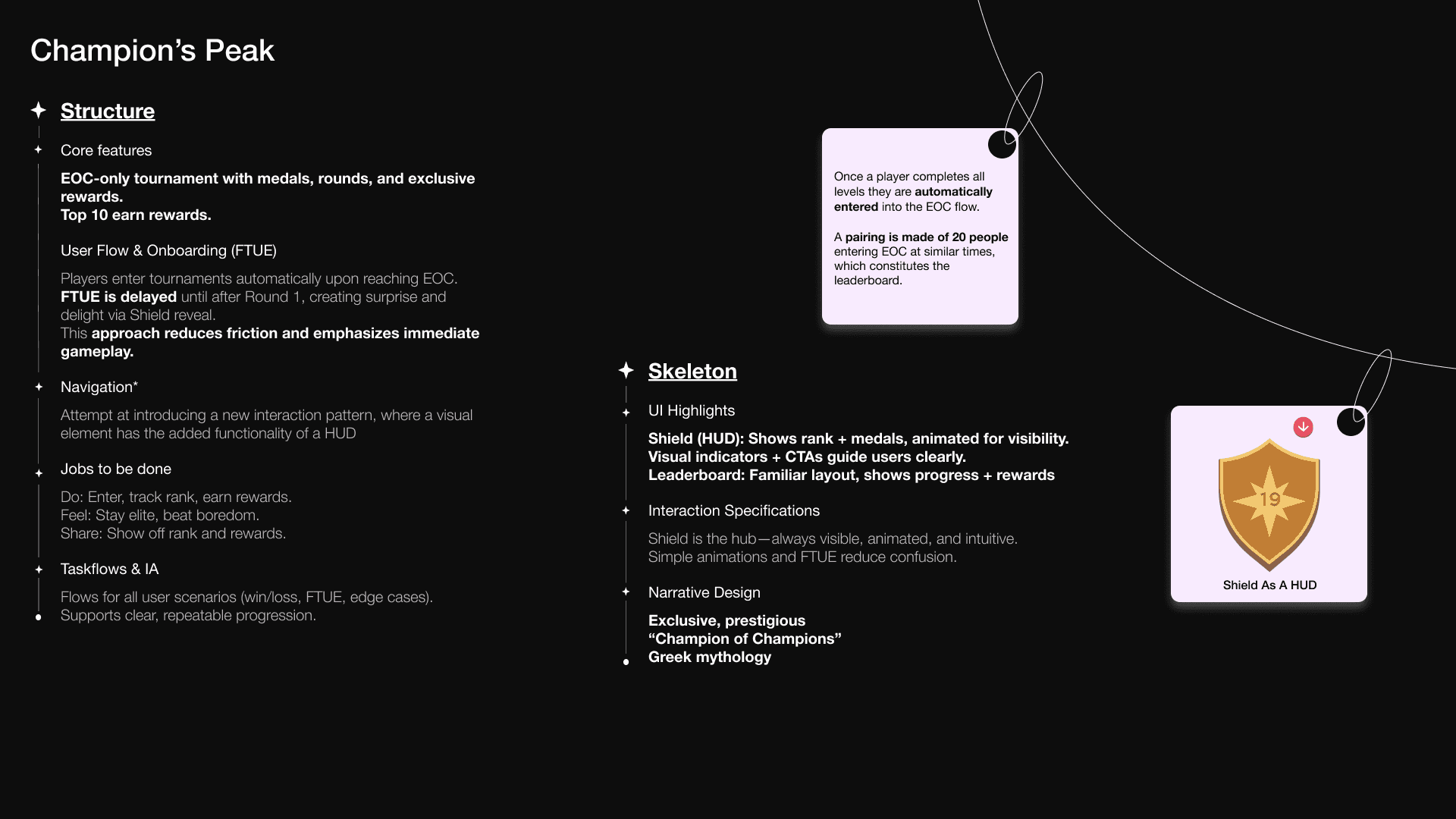
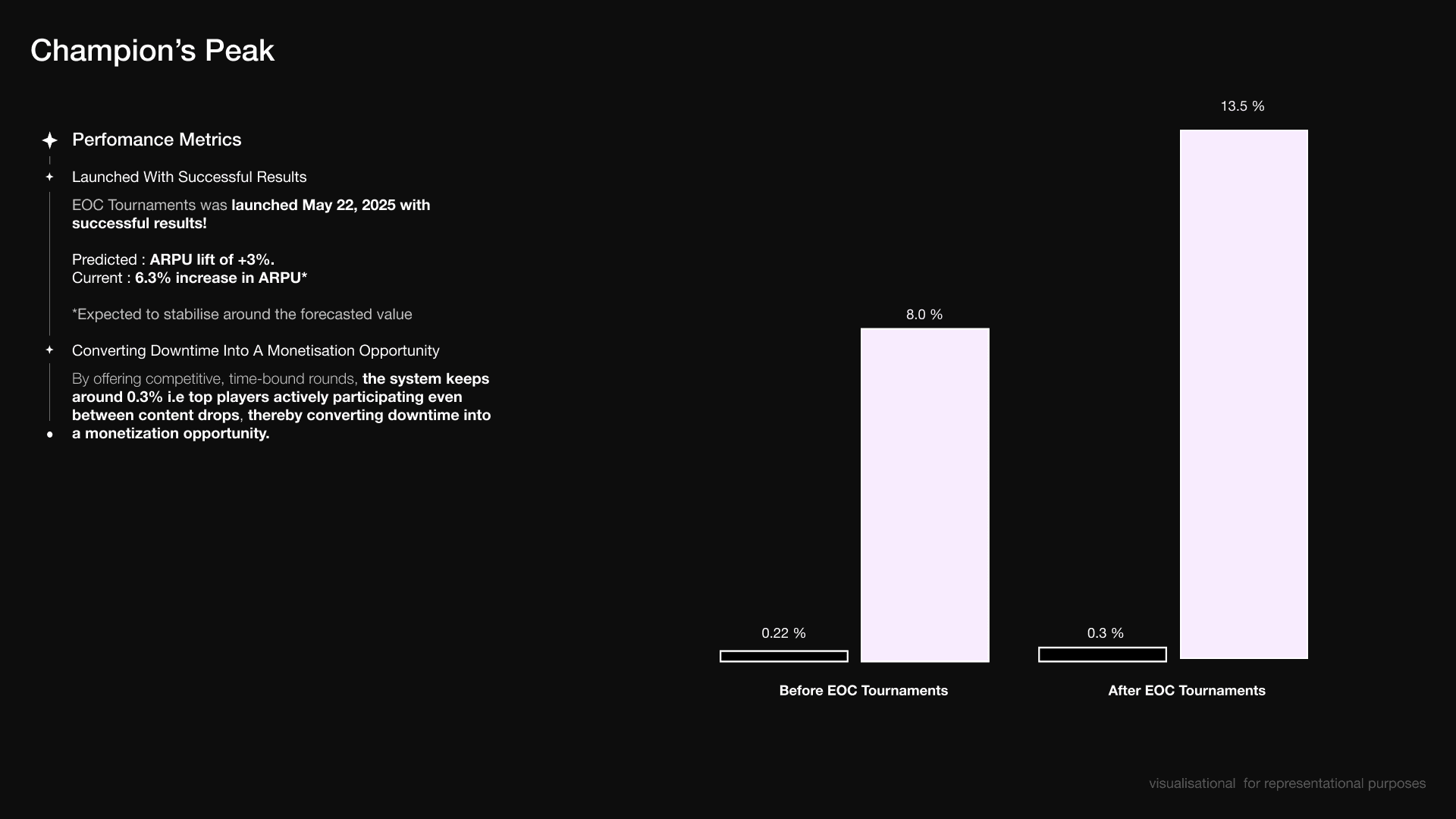
Shipped four high-impact features, such as the game’s first End of Content (+6.3% gold spend), a Profile system upgrade, and two Live Ops features (+5.5% IAP + Ad ARPU).
Delivered revenue-driving features by strategically aligning player needs, business goals, and global collaboration, optimizing for engagement, retention, and growth.
Introduction
In the highly competitive mobile gaming sector, monetization is vital for business sustainability, yet aggressively implemented strategies risk alienating players and harming long-term retention. Games like TwoDots, with a loyal, casual player base and over 100 million downloads, must find an ethical, enjoyable balance between generating revenue and preserving player satisfaction.
My internship with Zynga challenged me to design player-first features that foster engagement and enable monetization without diminishing the calming, rewarding core of TwoDots.
Problem Statement
The mission was grand but clear: "How might we design for monetization while balancing player engagement to ensure a rewarding and sustainable experience?"
Background: Zynga and Match 3 Games
Zynga, a name synonymous with titles like FarmVille and Words With Friends, has focused its efforts on live, data-driven games. The company’s vision: "connecting the world through games."
TwoDots, a stylish, minimalist game, stood out in Zynga's portfolio for its calming design, deep challenge, and thriving global community.
As I joined the team, I met not just code and pixels, but a family of developers, artists, and strategists—united in the pursuit of fun and sustainable engagement.
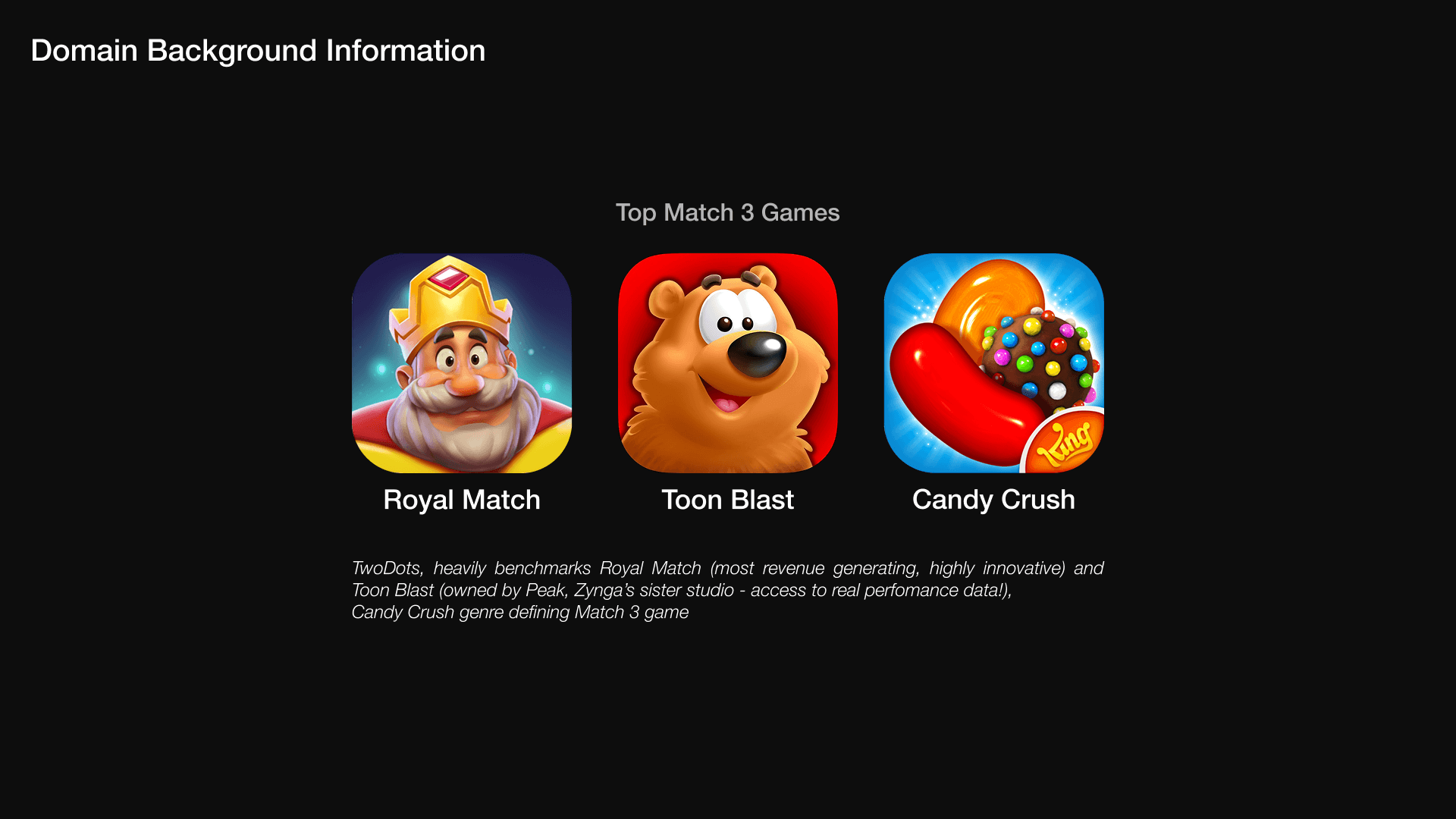
The domain behind Match-3 games was rich and storied—dating back to Tetris, refined by Bejeweled, and revolutionized by Candy Crush. These games thrived on progressive challenges, reward loops, and ever-evolving feature sets. But in this competitive space,
standing out meant more than a clever game mechanic—it required empathy and innovation.
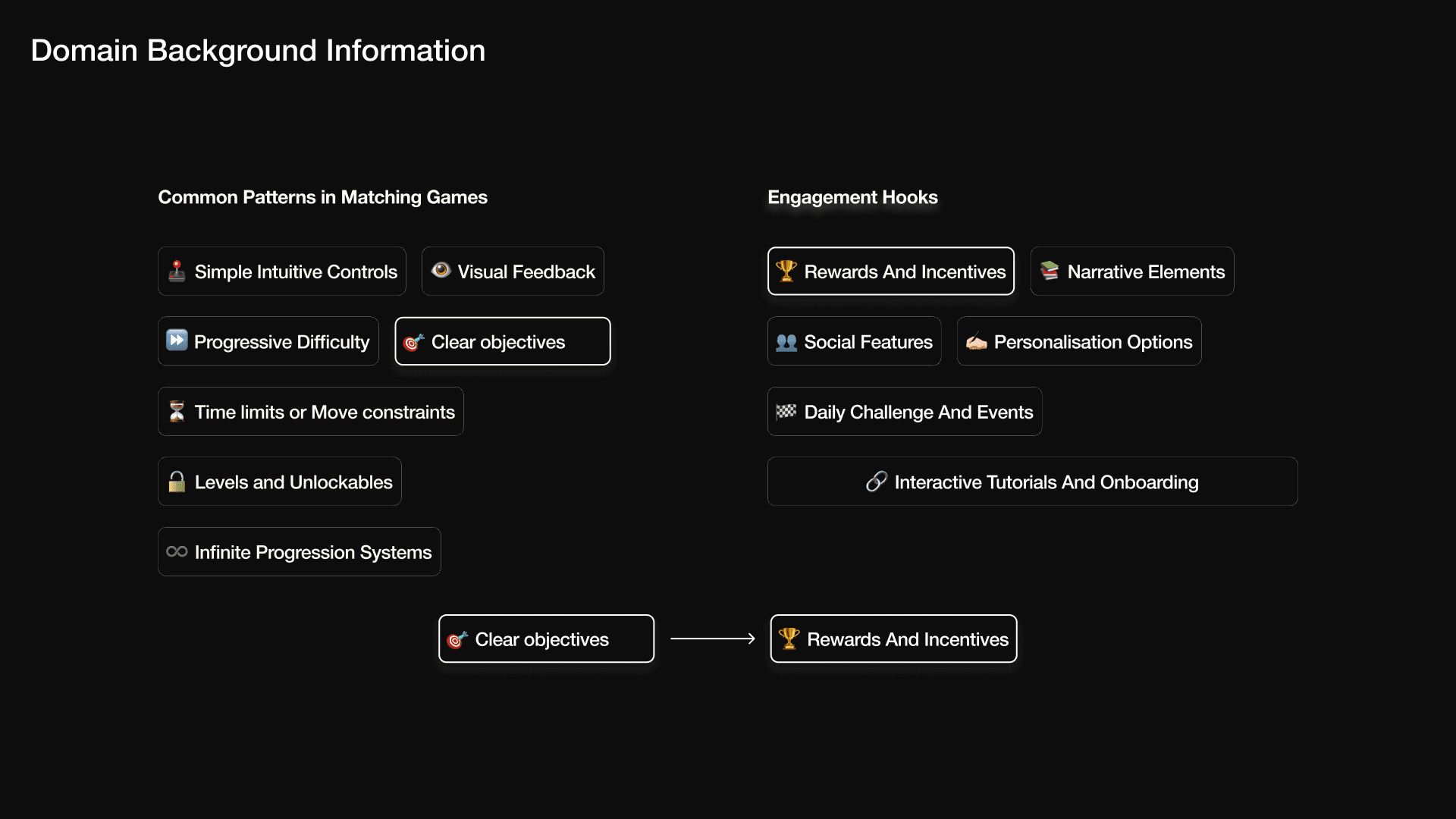
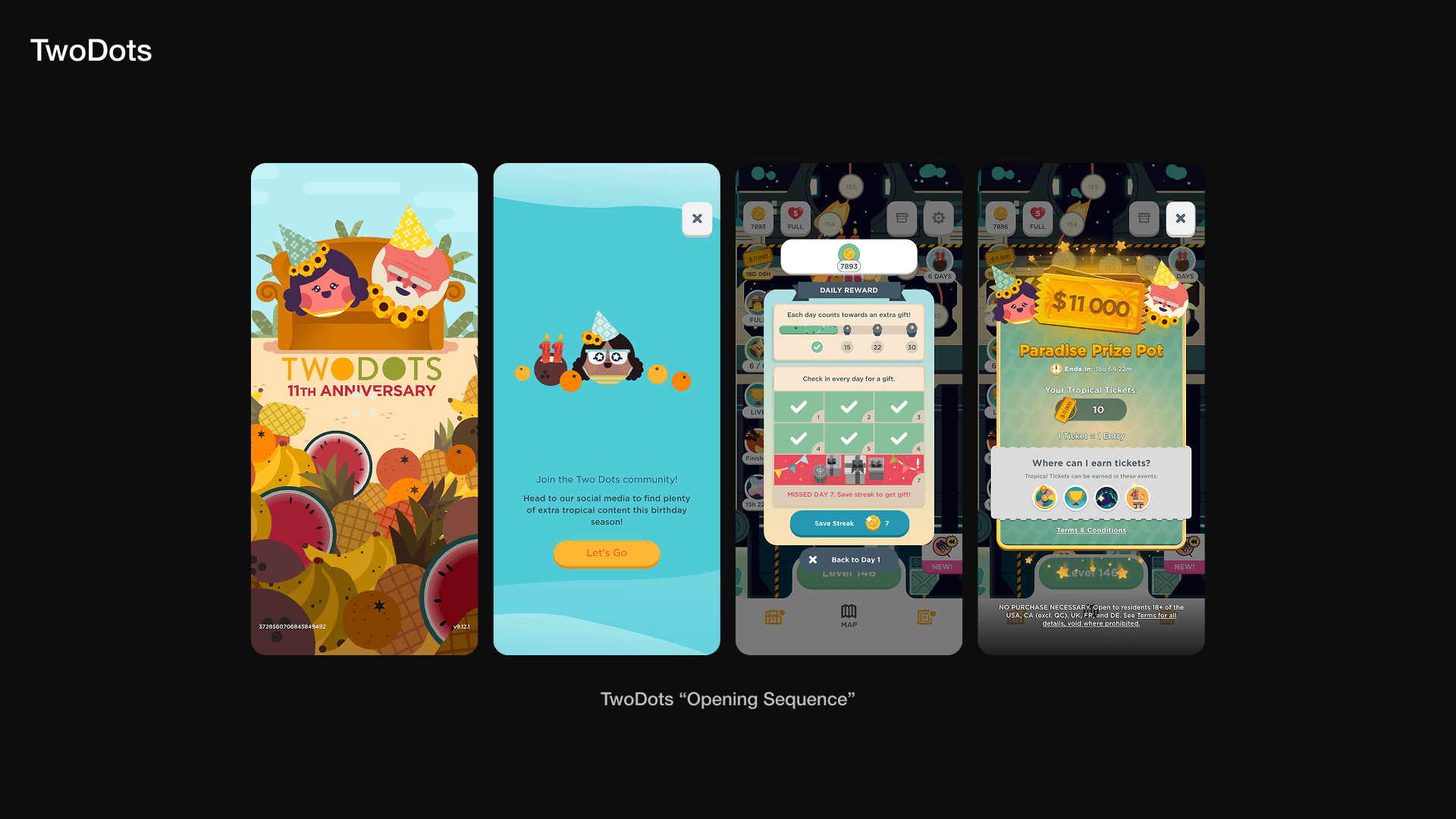
I began by observing engagement hooks: community leaderboards, daily challenges, calming design, and especially the psychological pull of progression. Monetization models ranged from gentle nudges to bold offers—always a careful dance between business needs and player trust.
Ways of Working
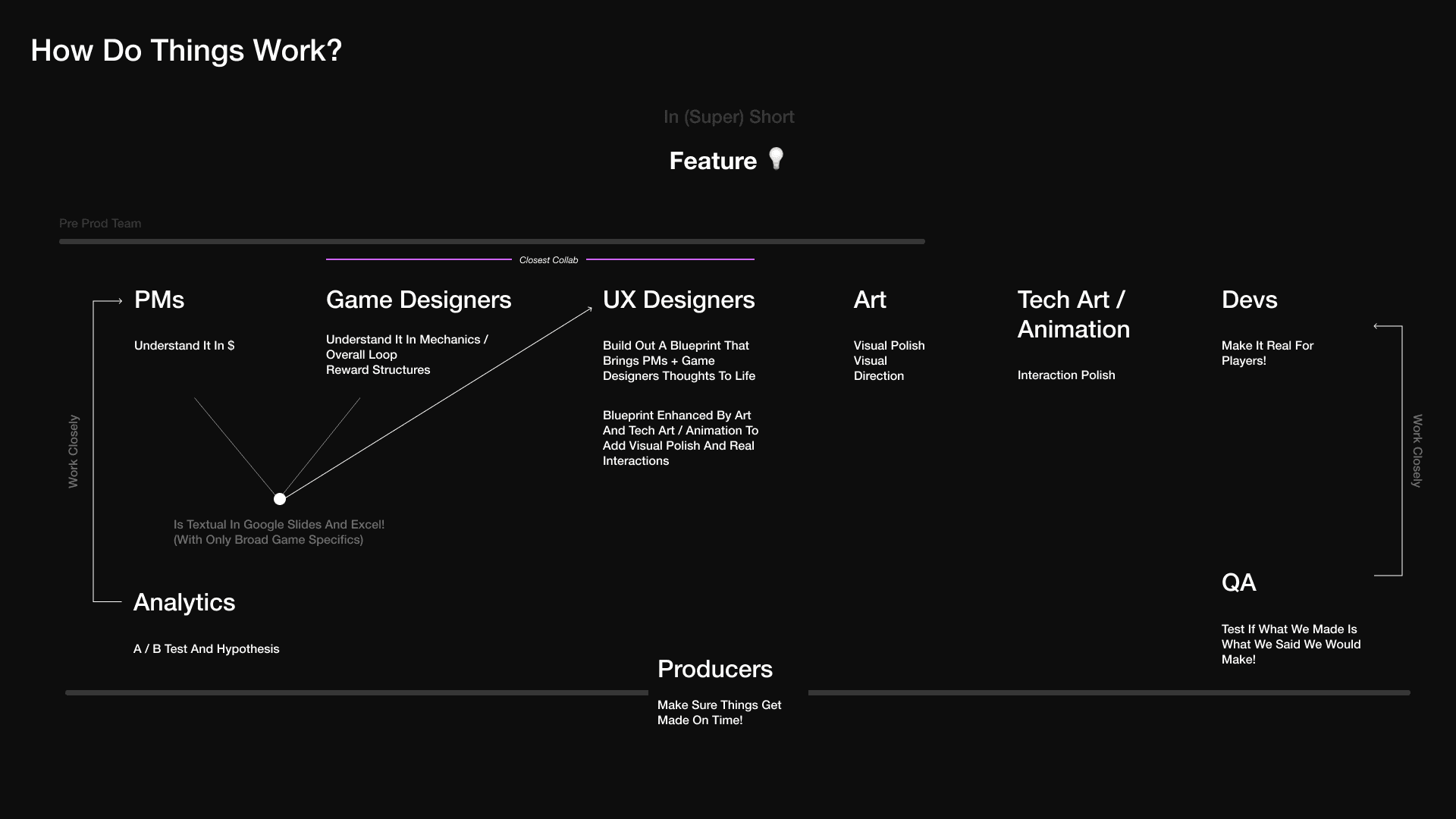
The India pod comprised of 24 people spread across 8 functions: Product, Game Design, UX, Art, Tech Art / Animation, Dev and Producer
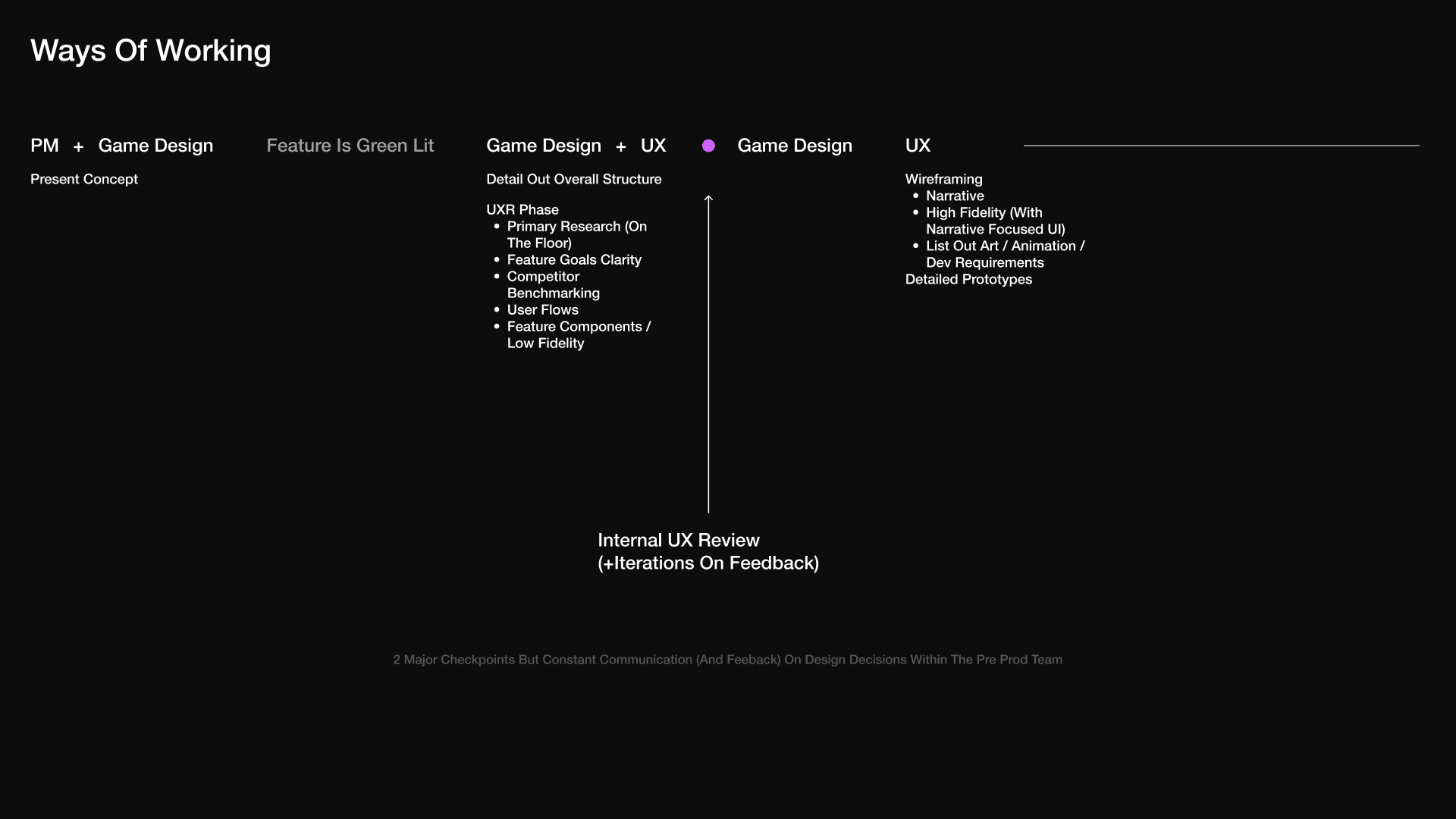
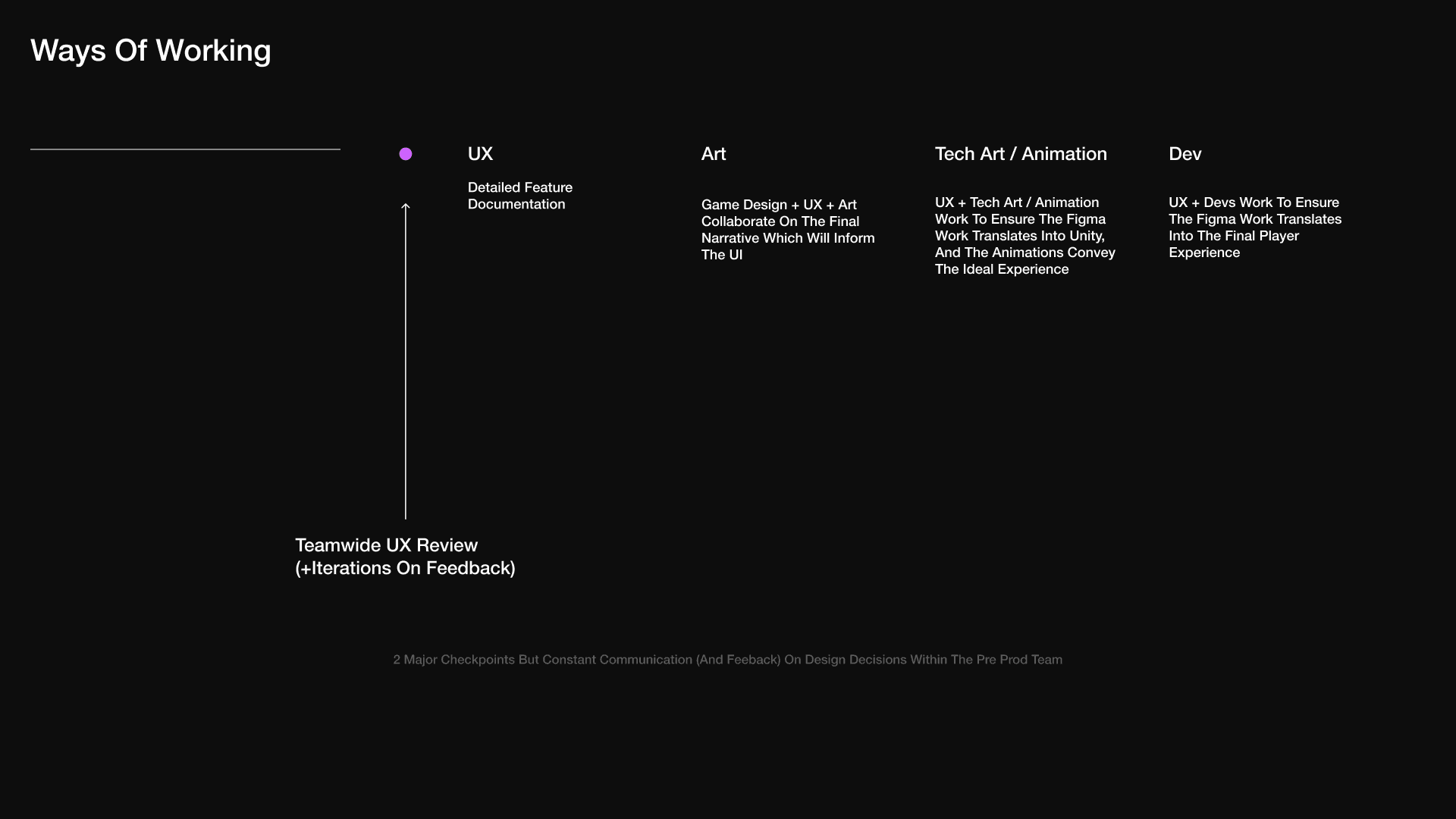
A super short explainer of the design process
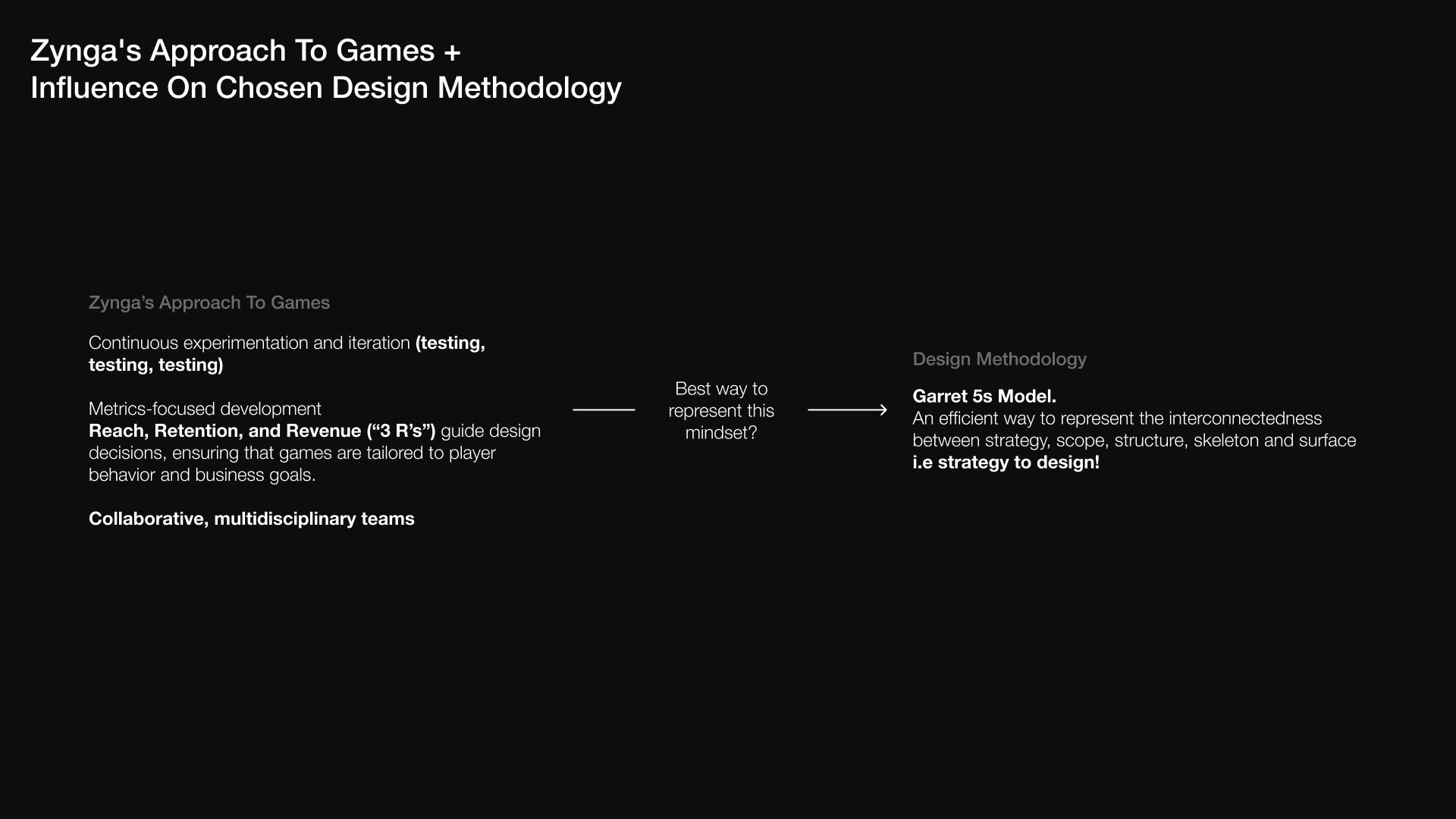
Zynga's approach to games + Influence on chosen design methodology
In short:
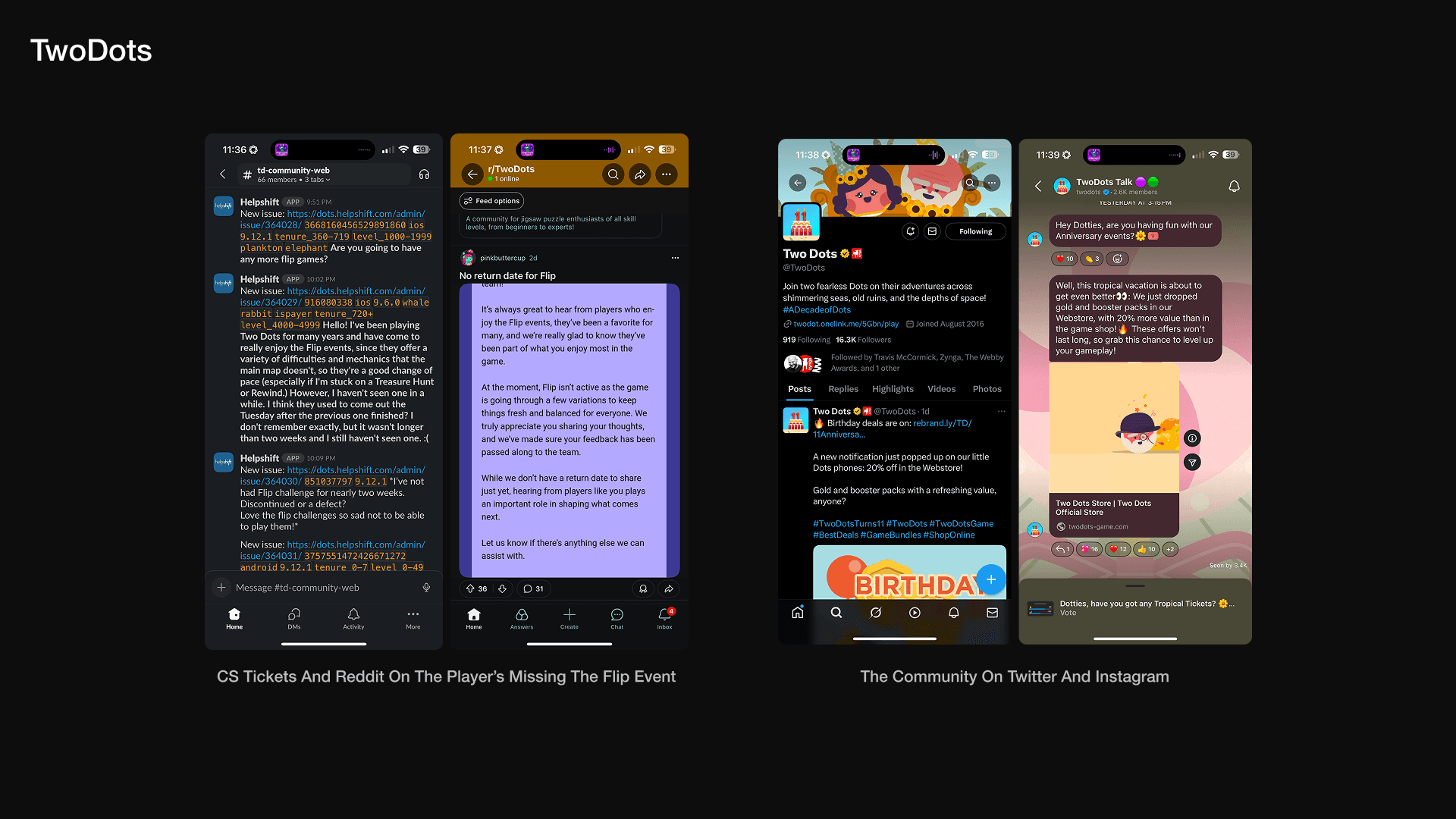
TwoDots
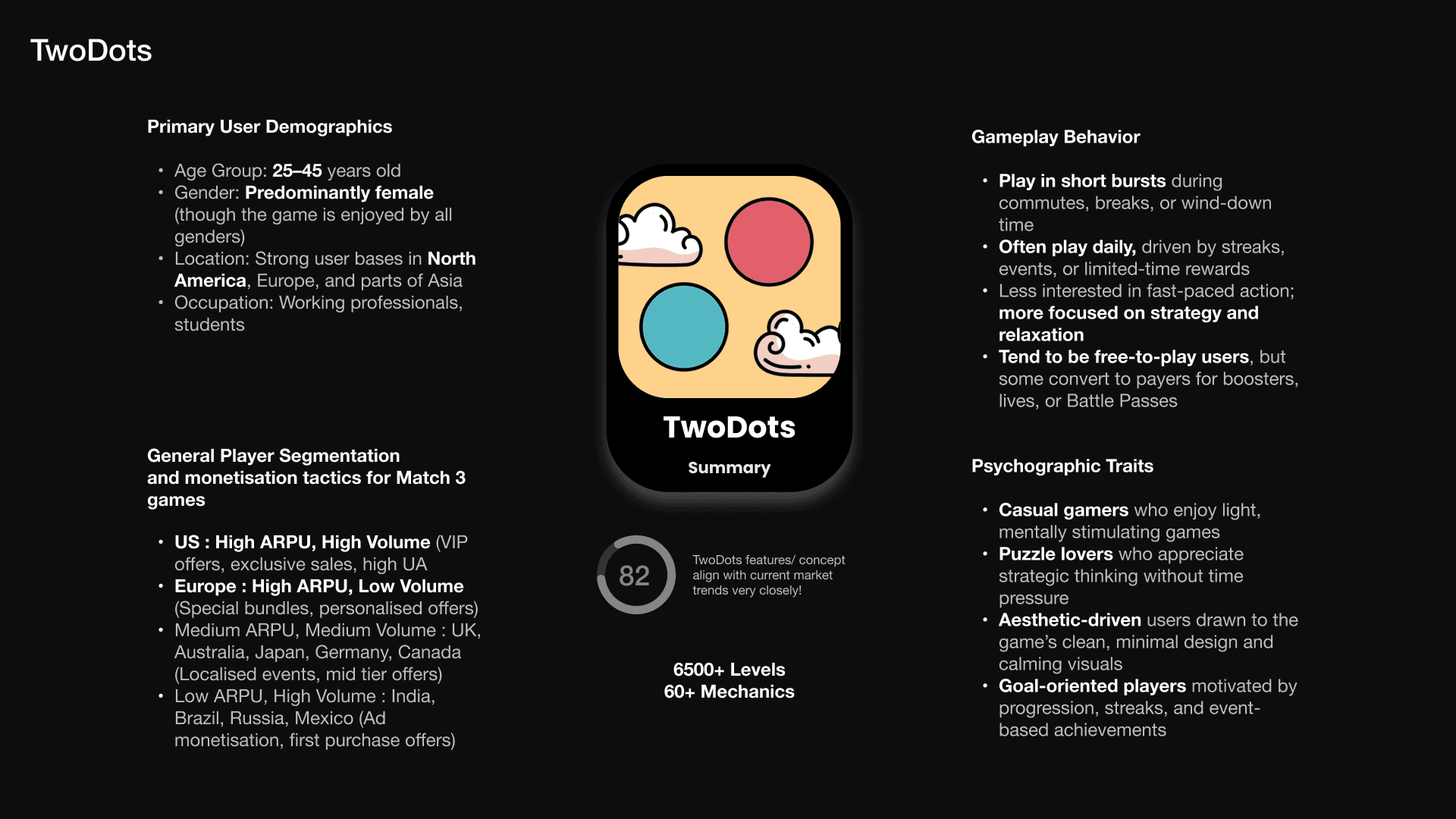
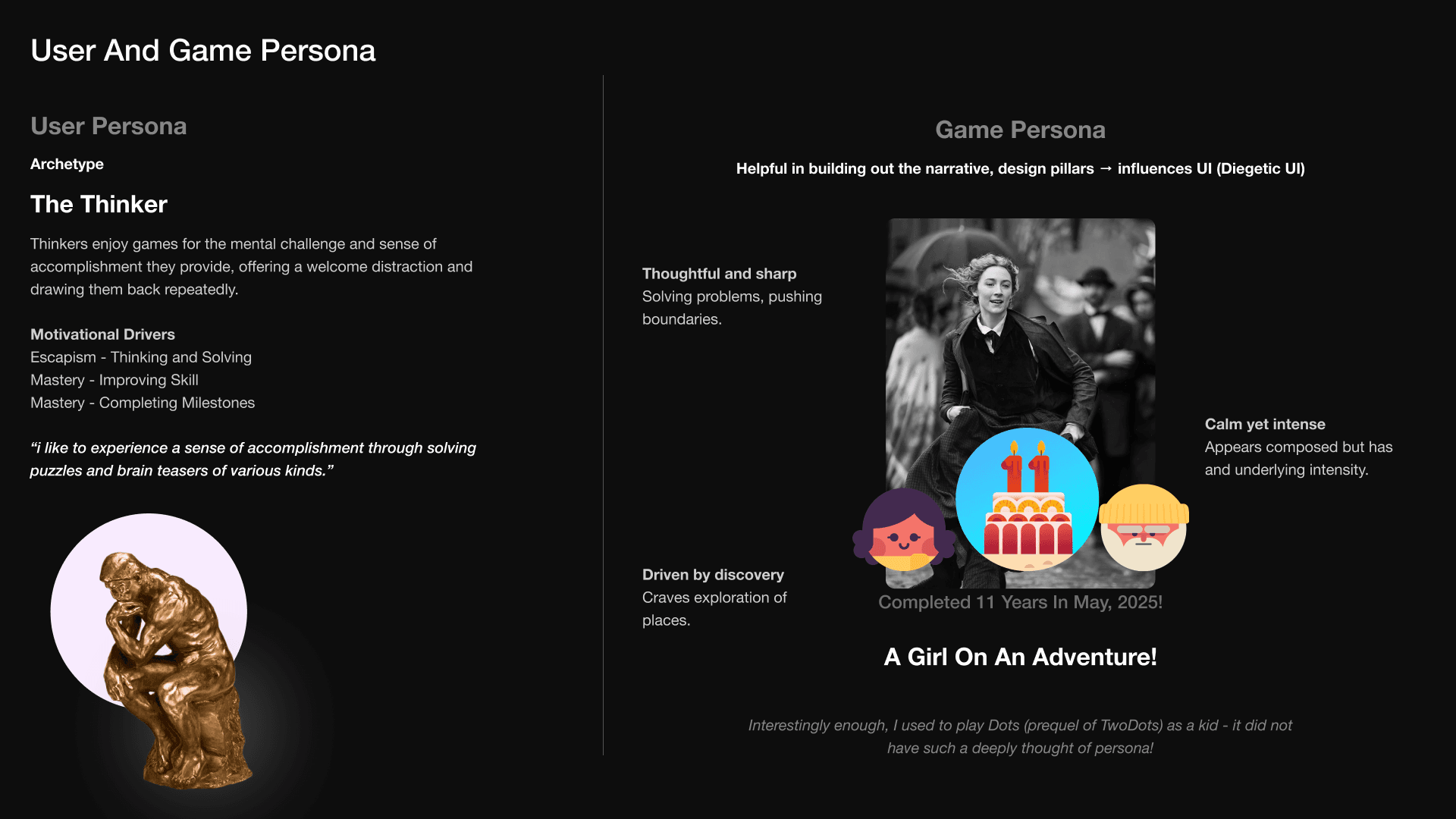
User and Game Persona
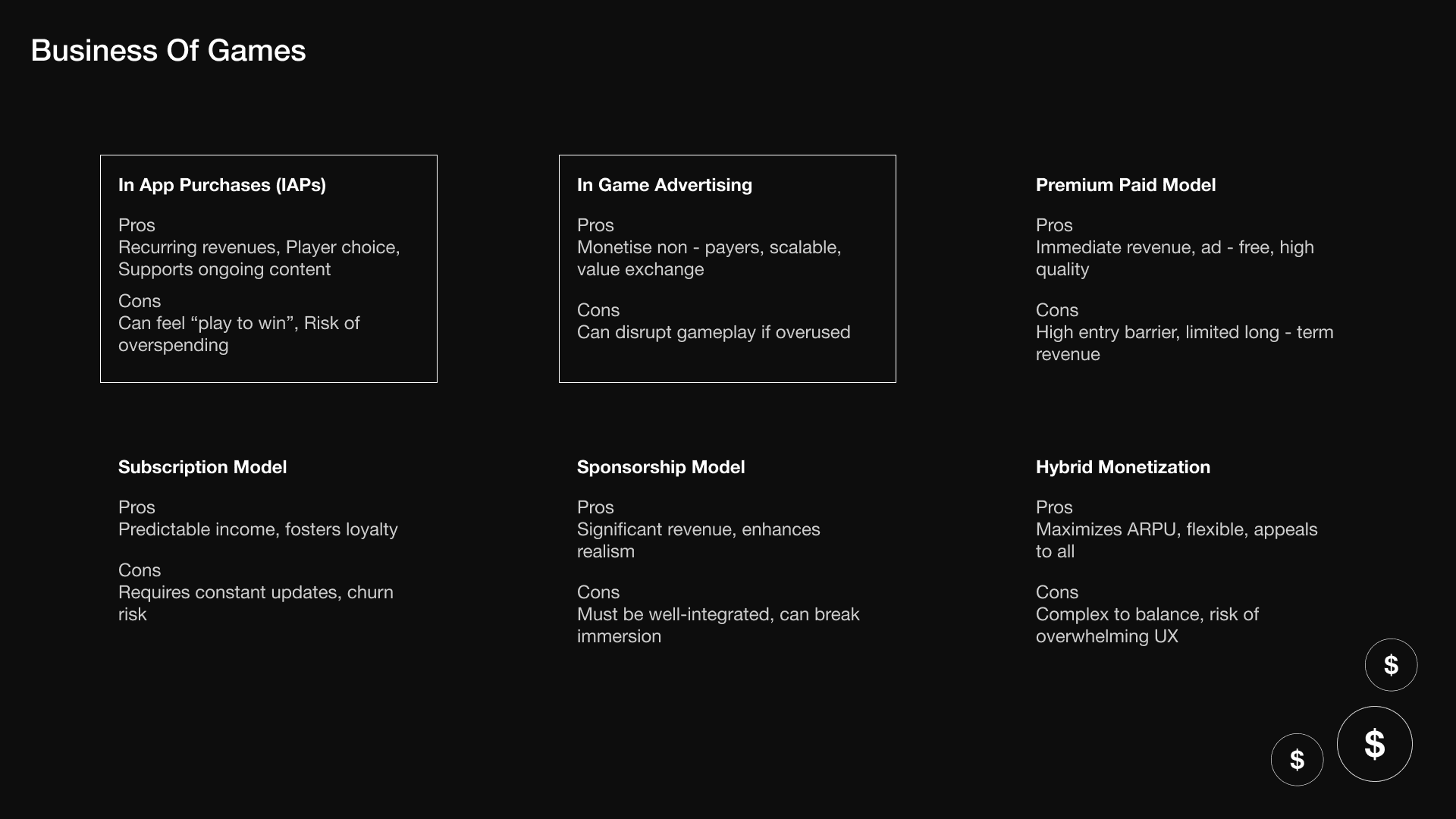
Business of Games
In short:
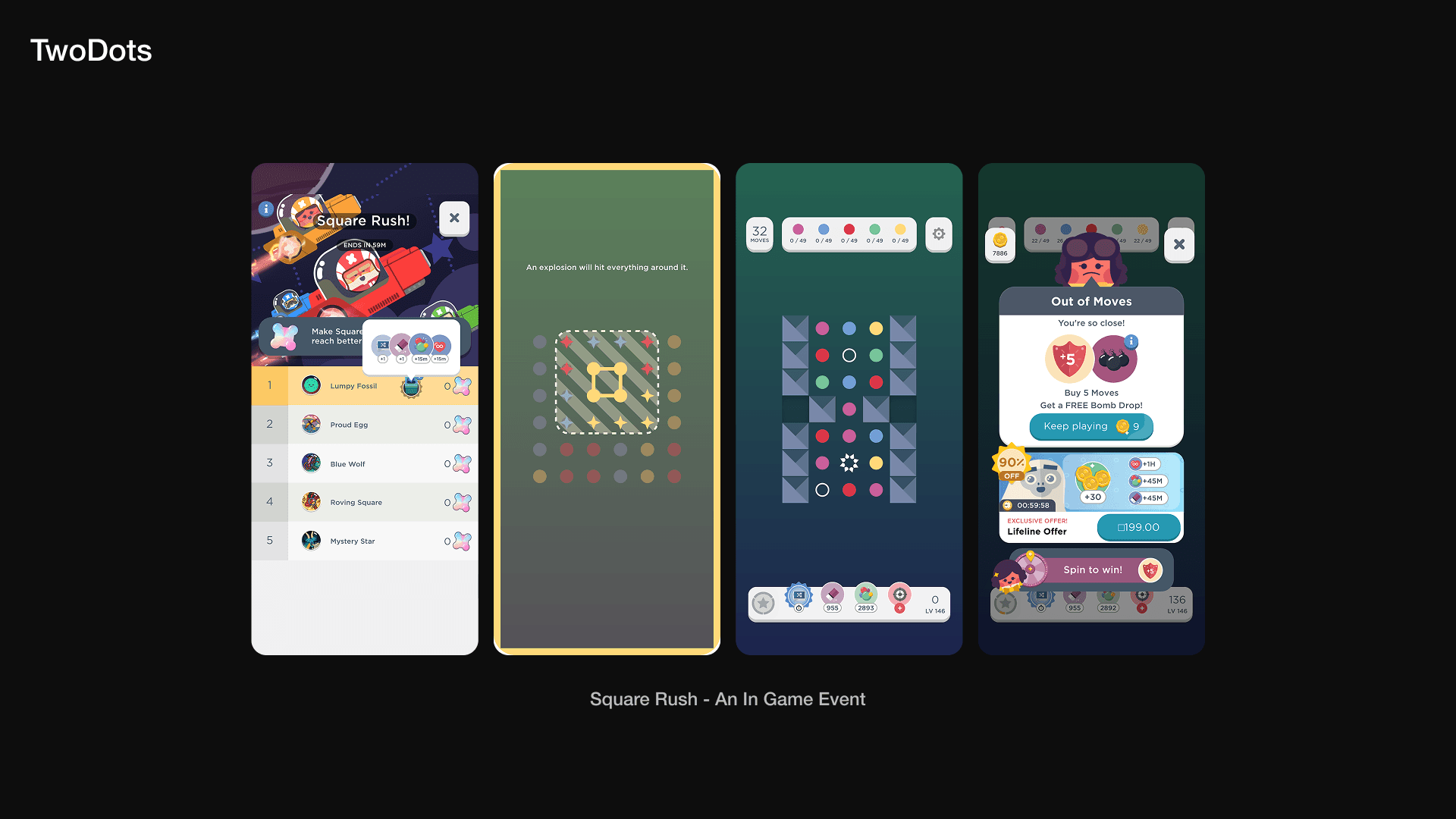
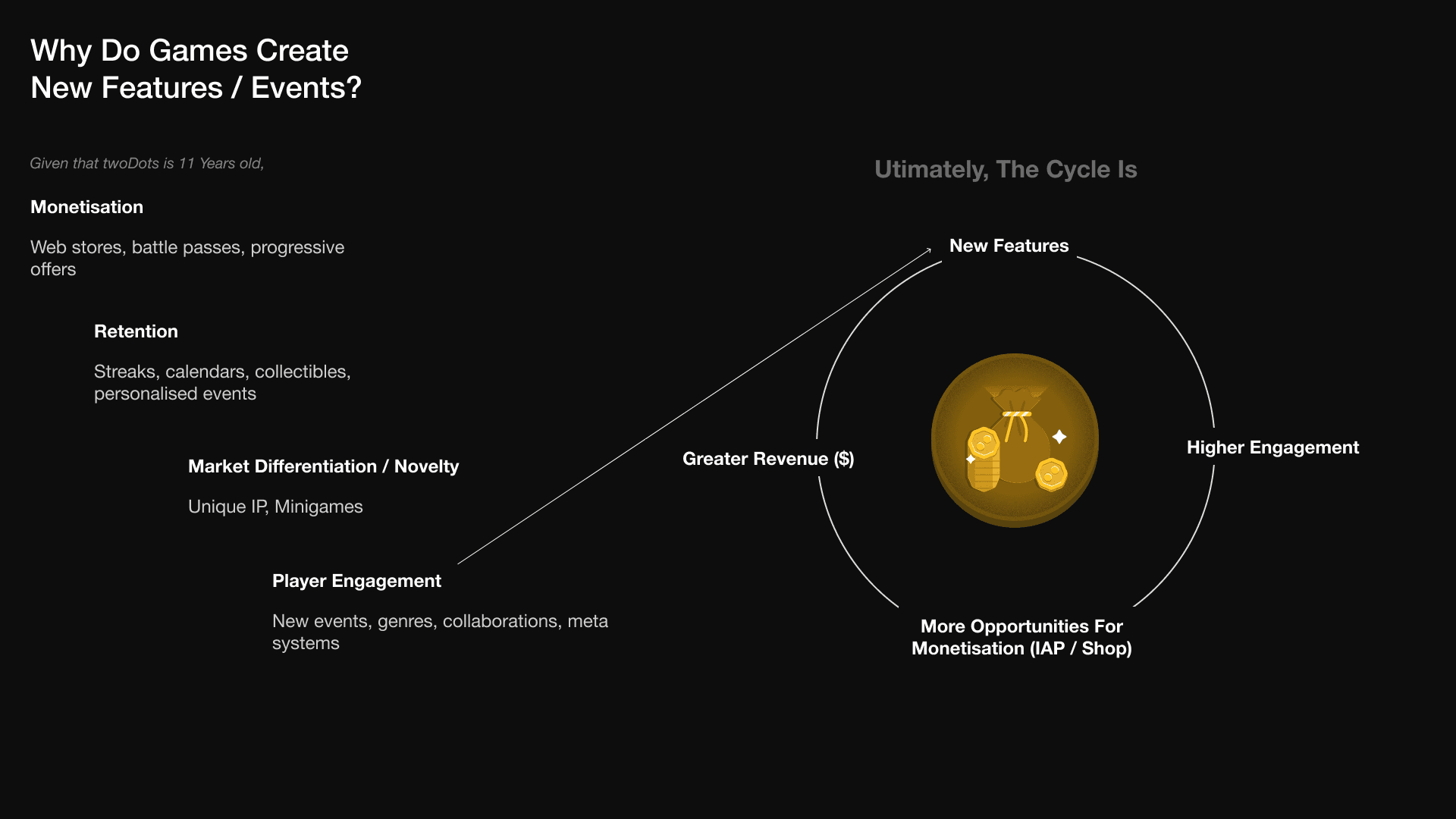
Why do games create new features / events?
Features I Worked On
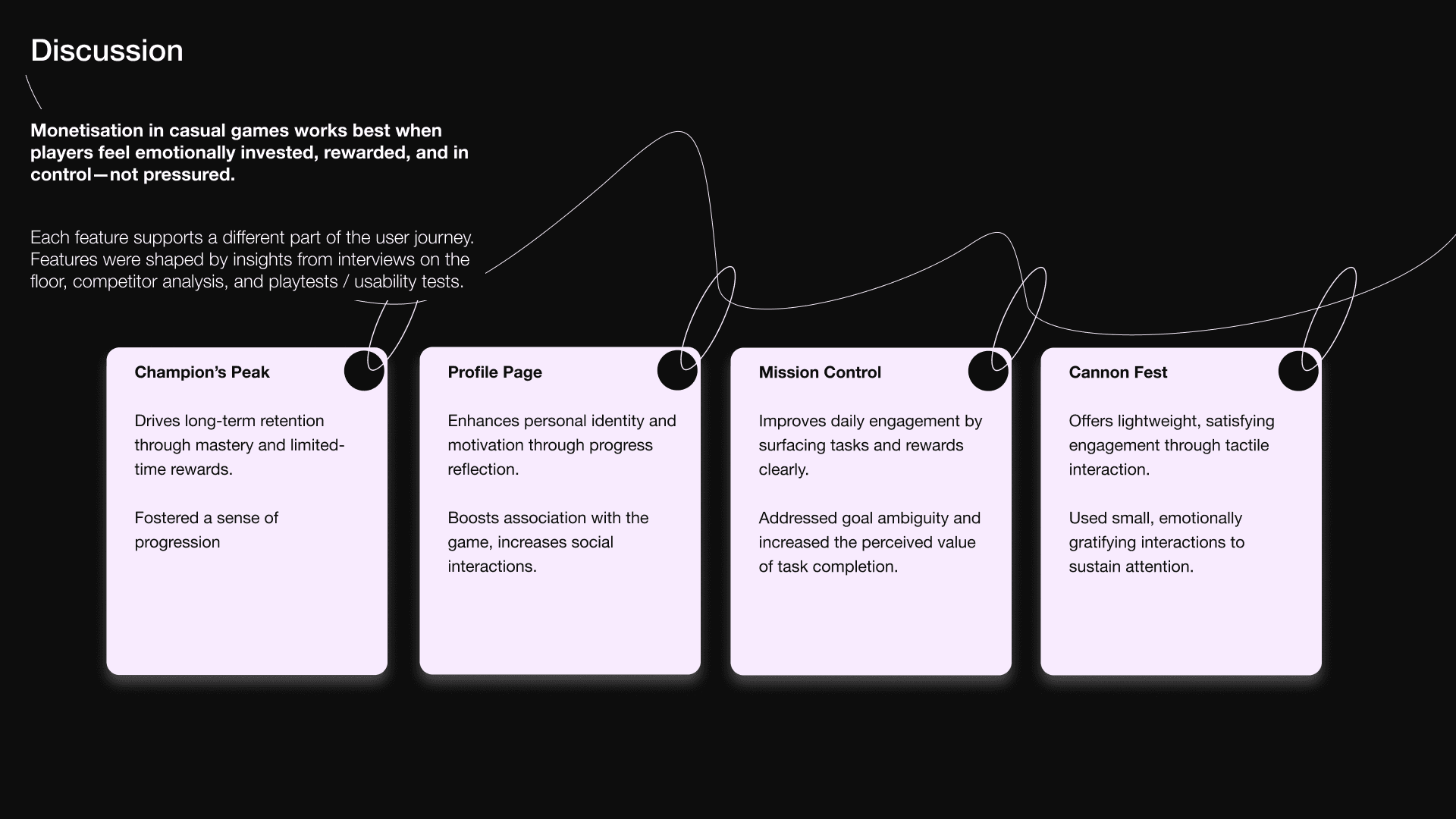
01 Champion's Peak
02 Profile Page
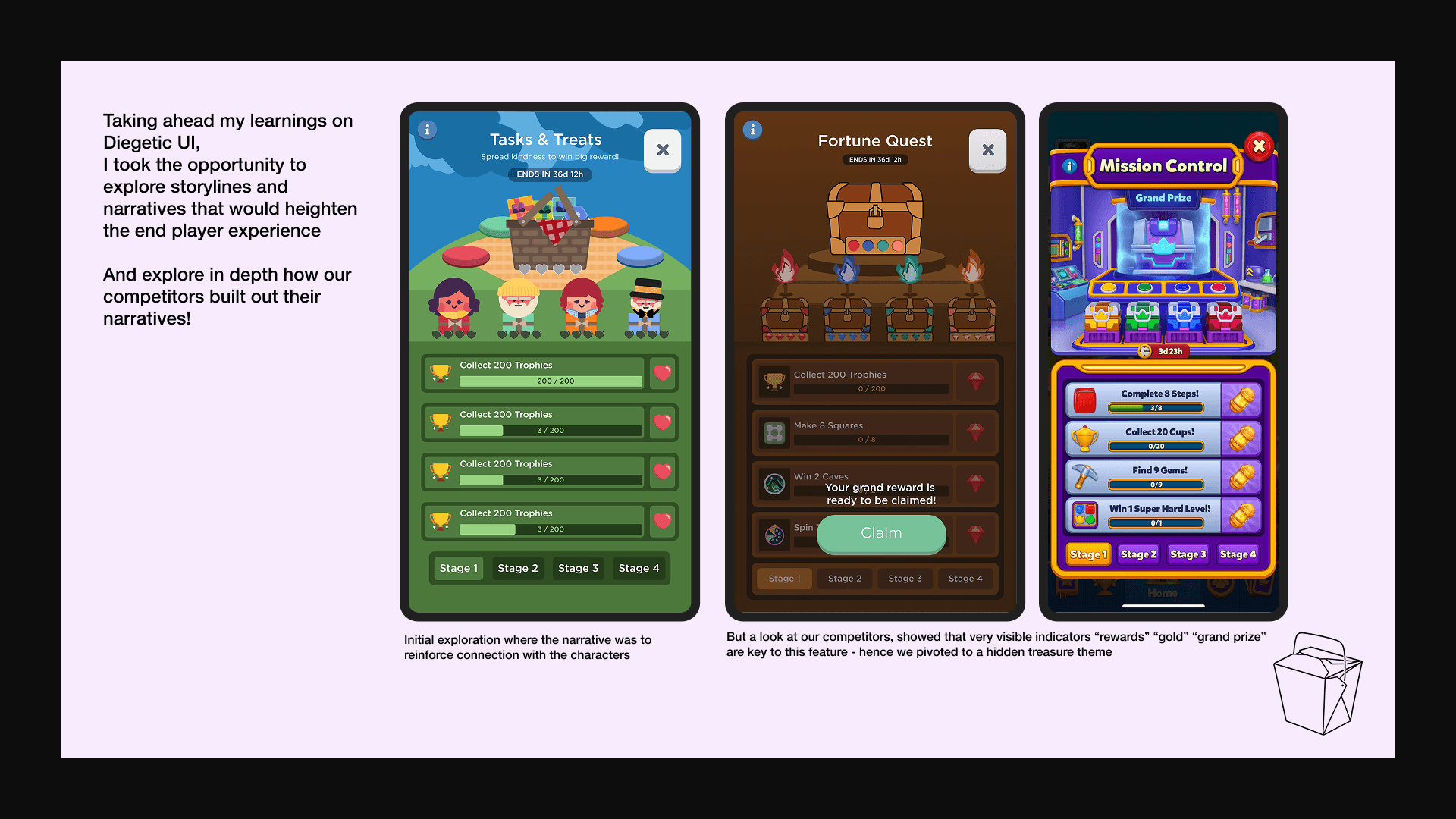
03 Mission Control
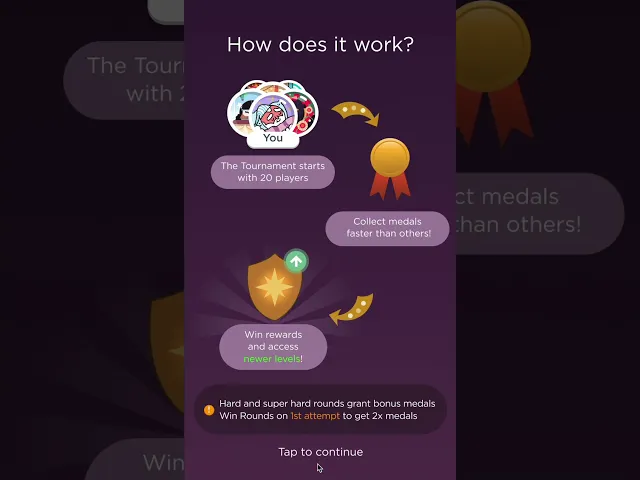
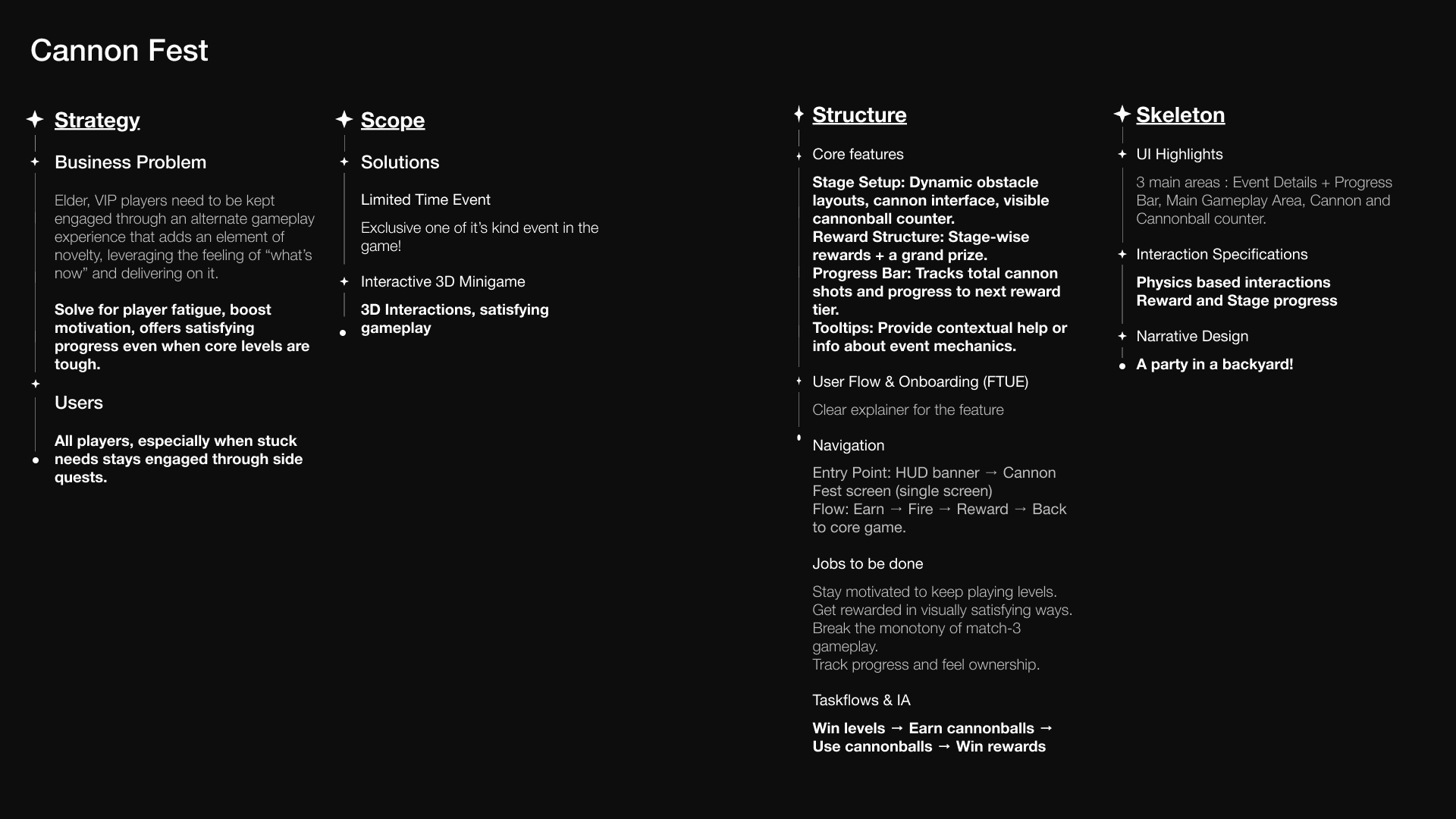
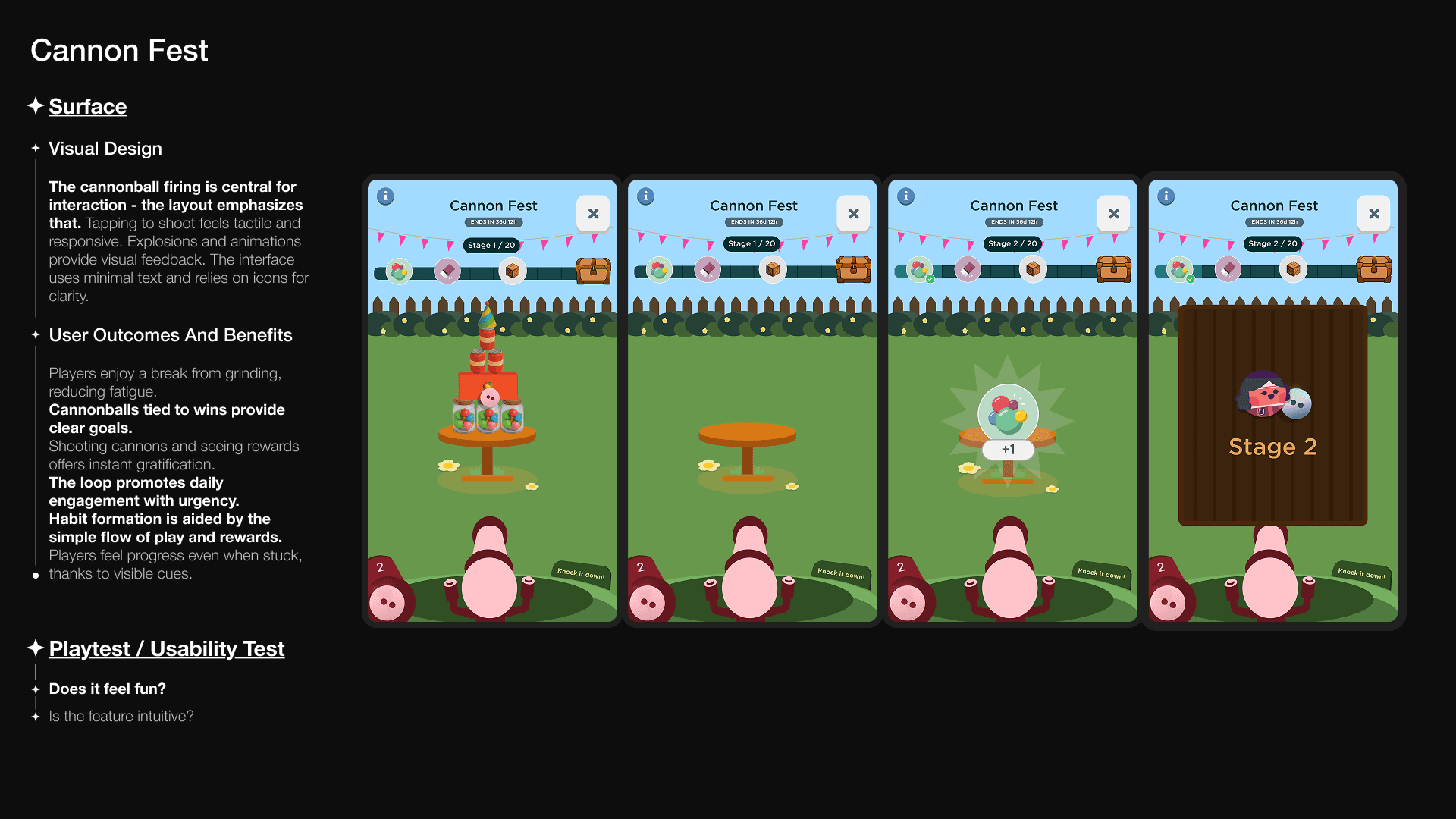
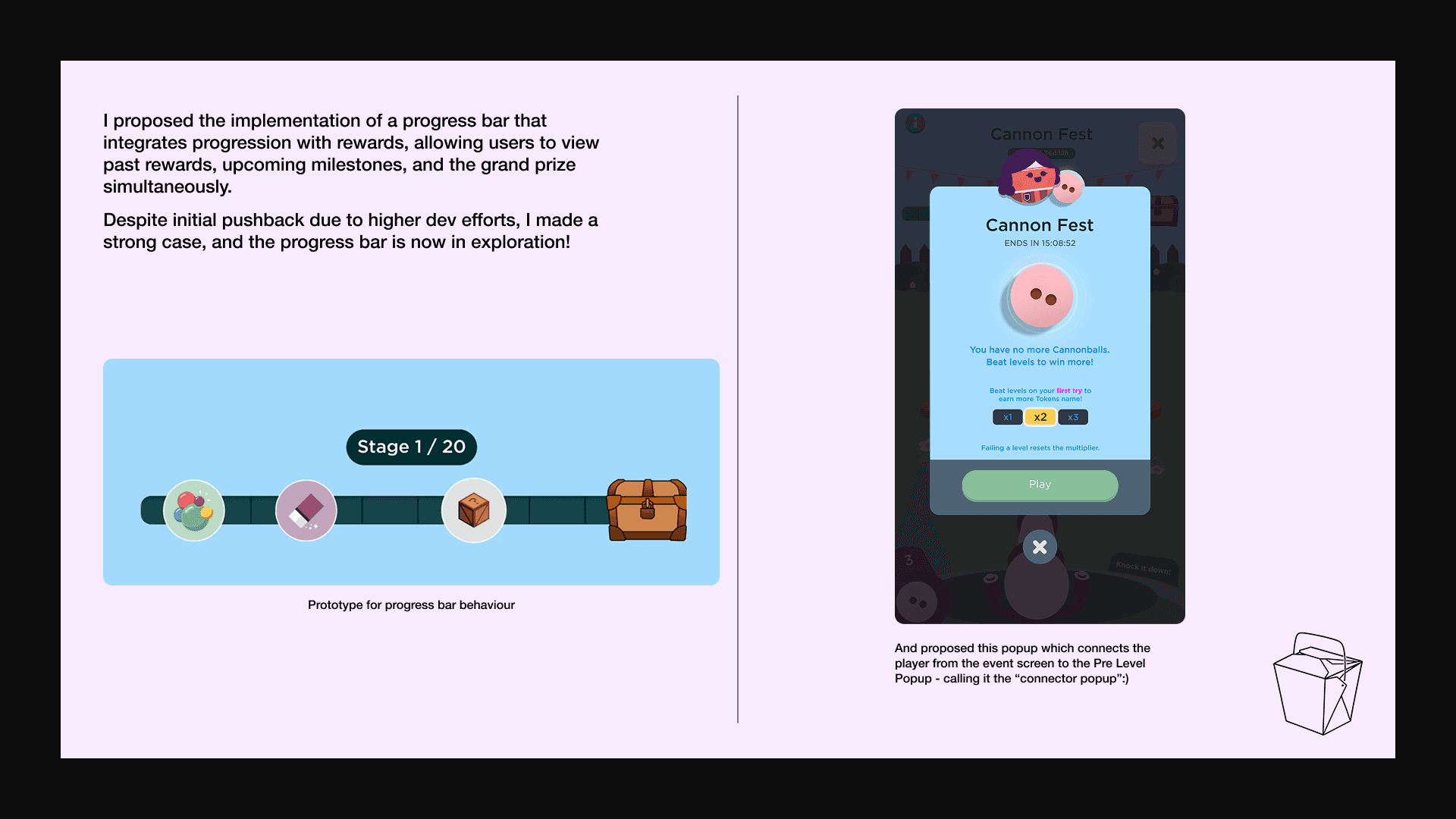
04 Cannon Fest
01 Champion's Peak
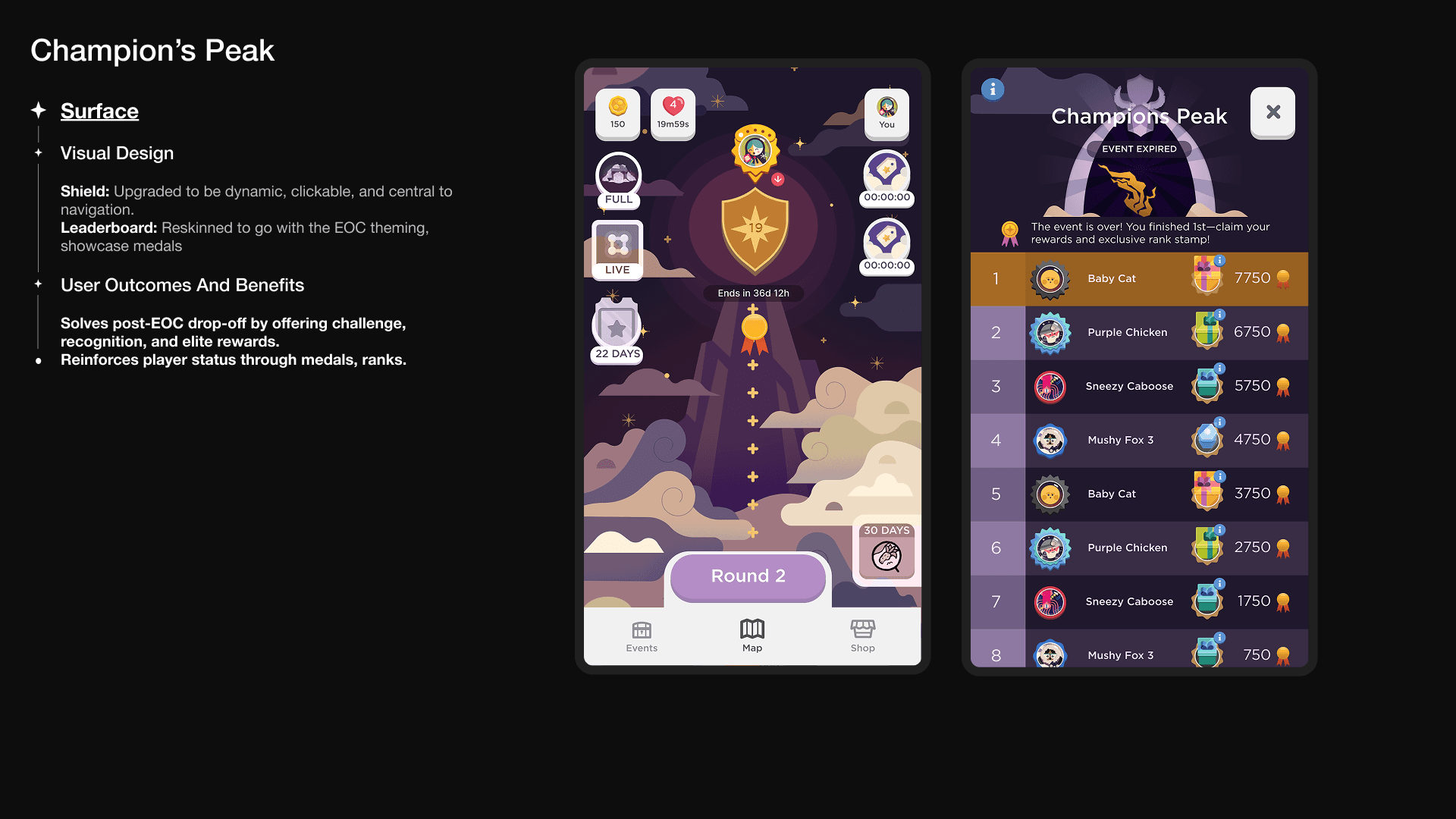
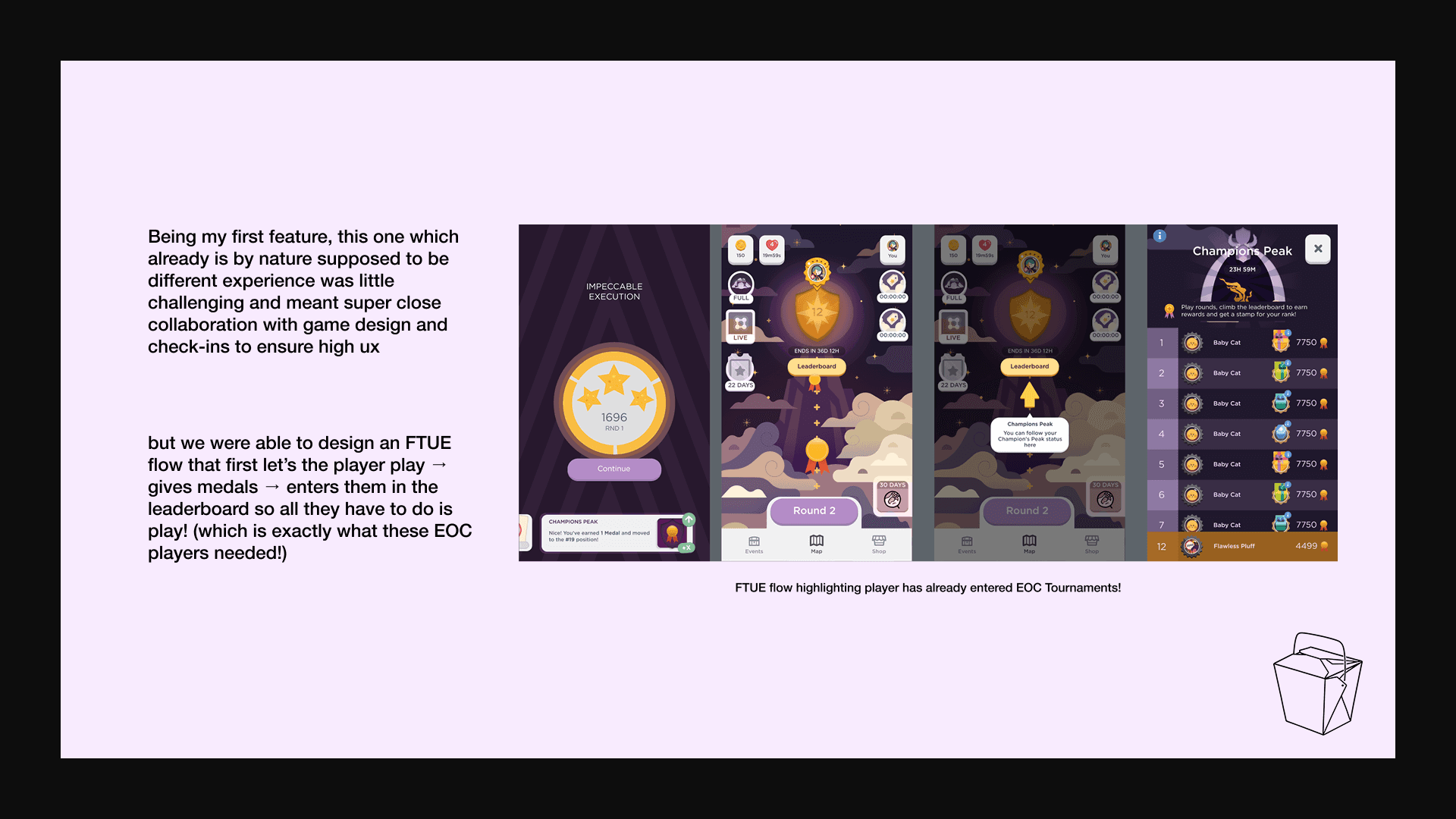
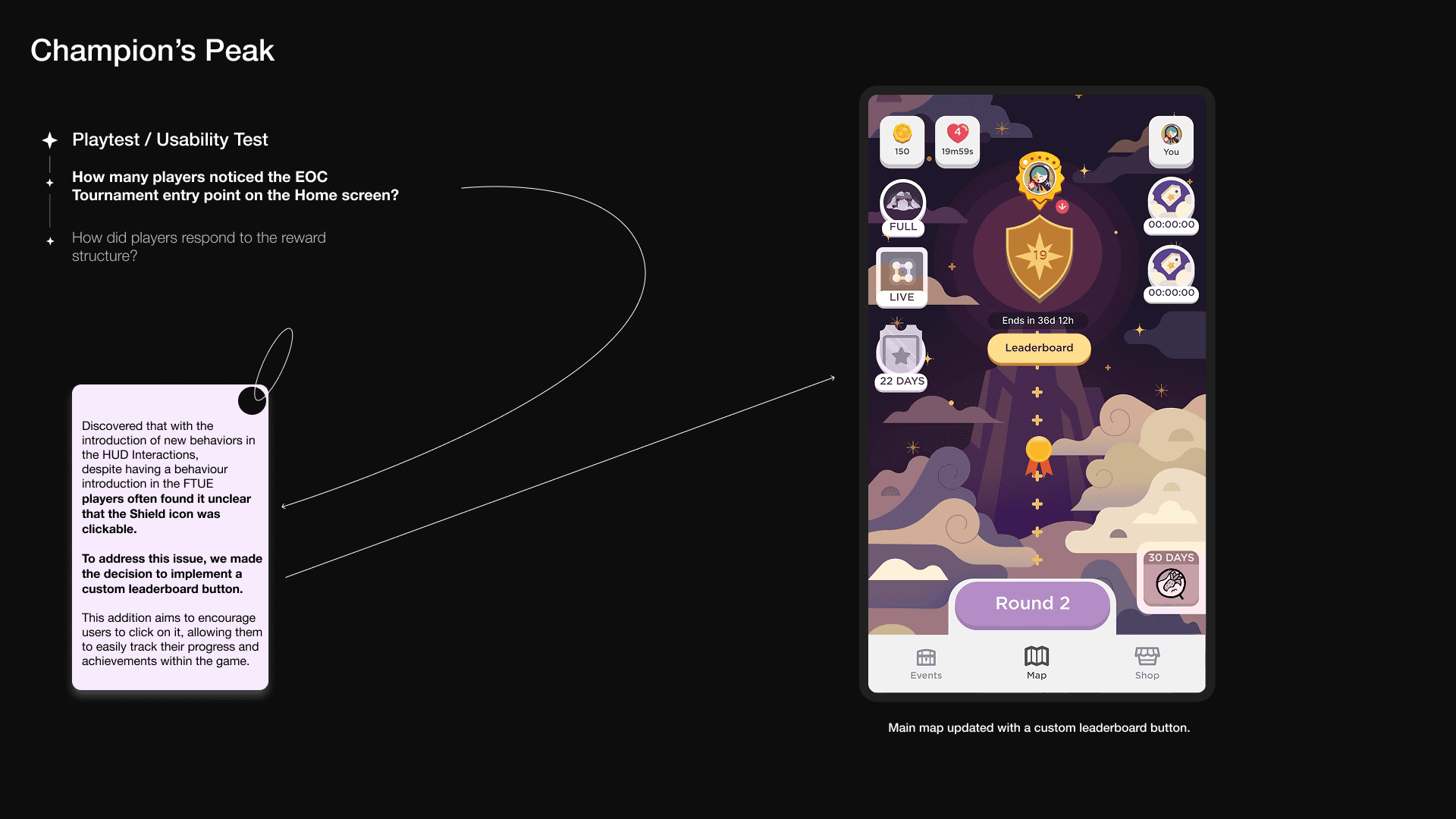
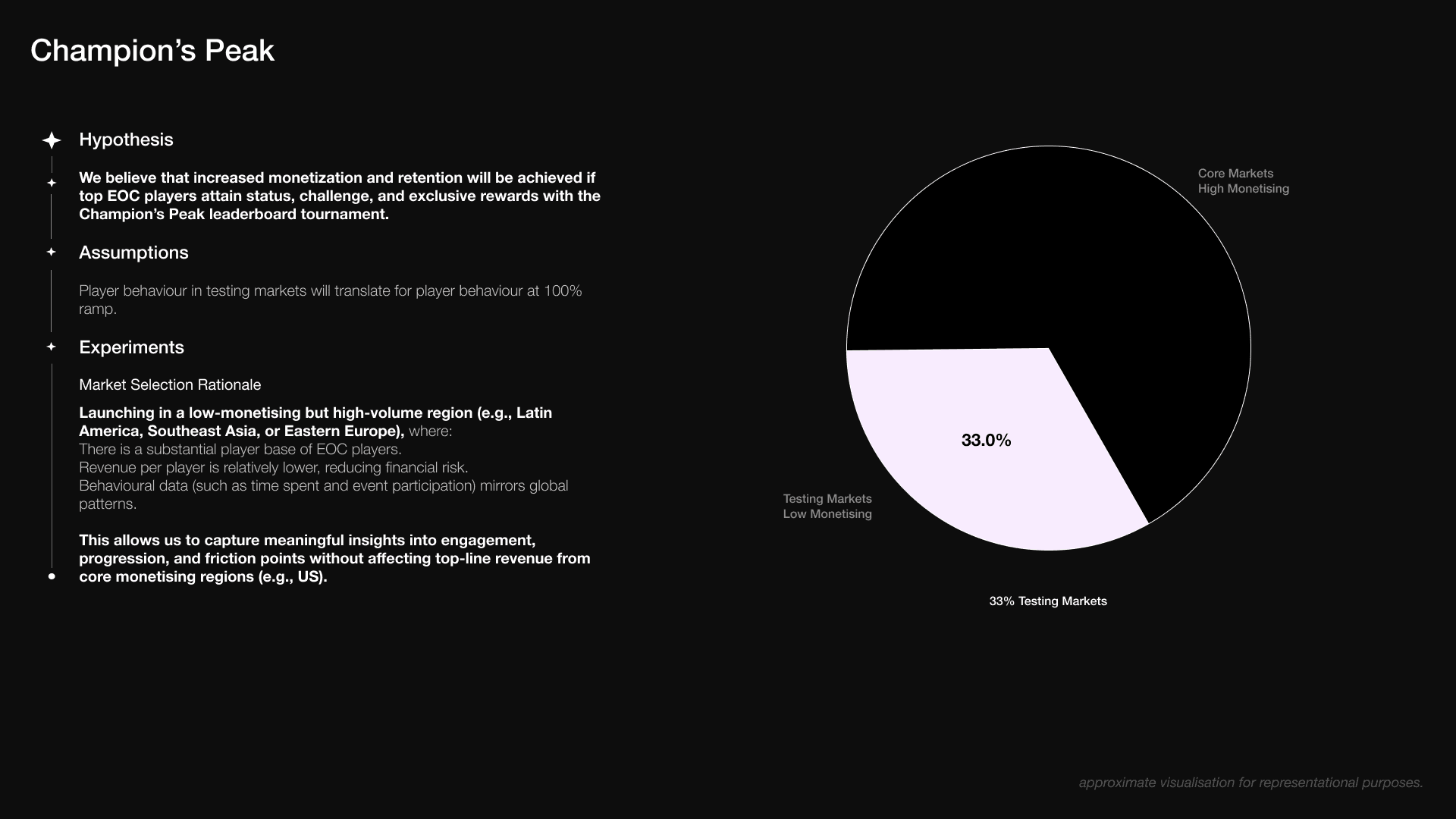
02 Profile Page
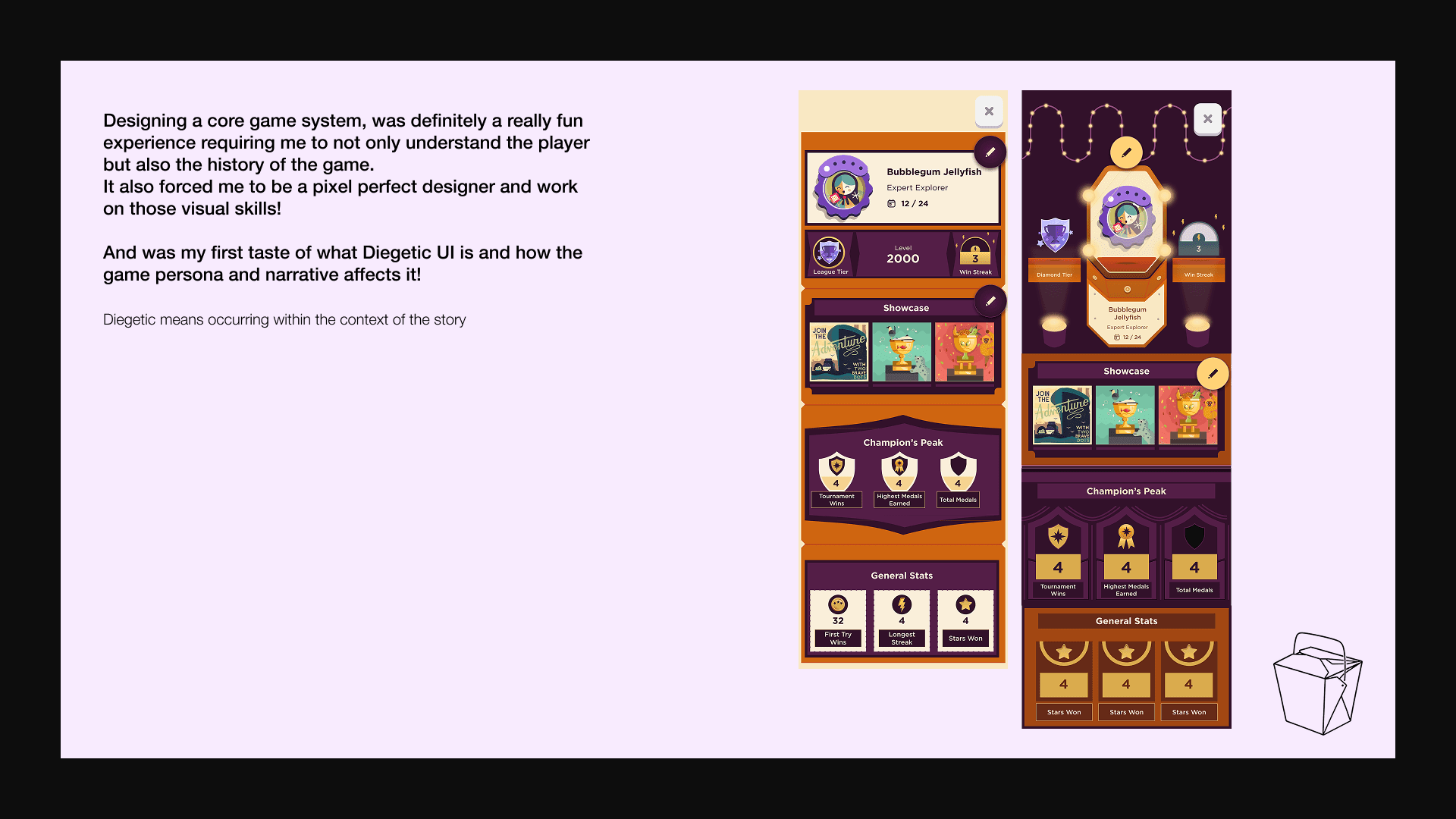
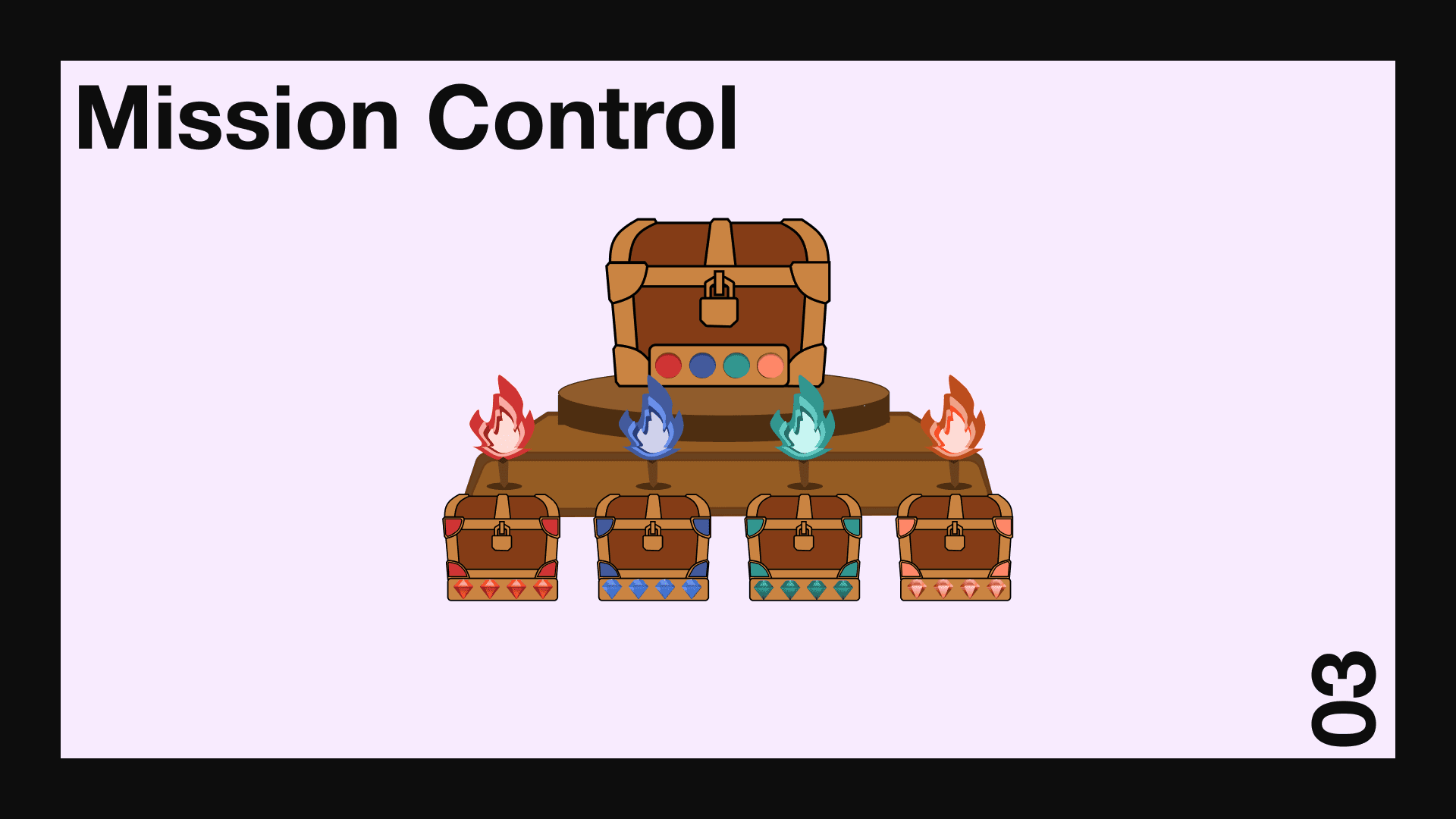
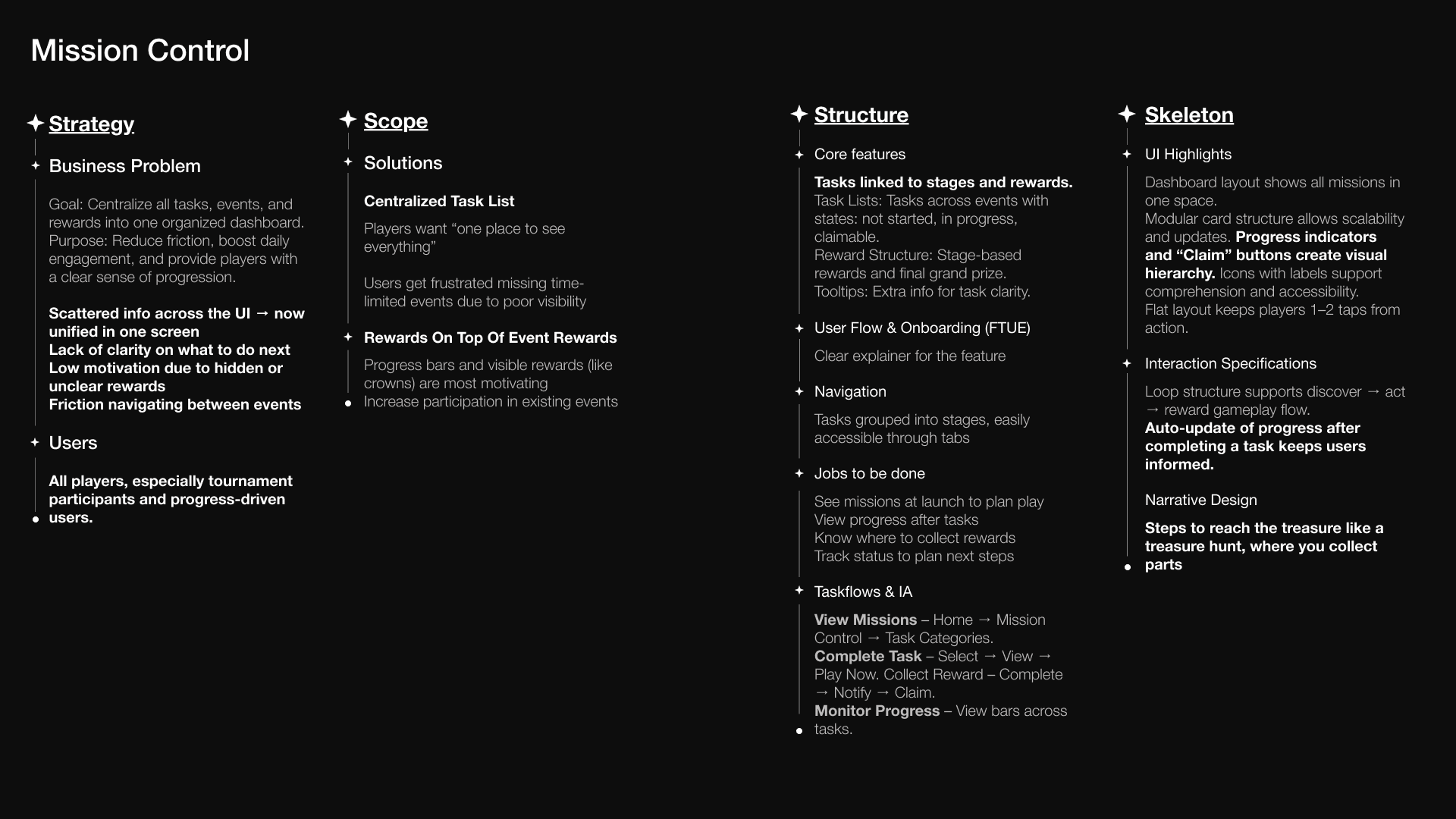
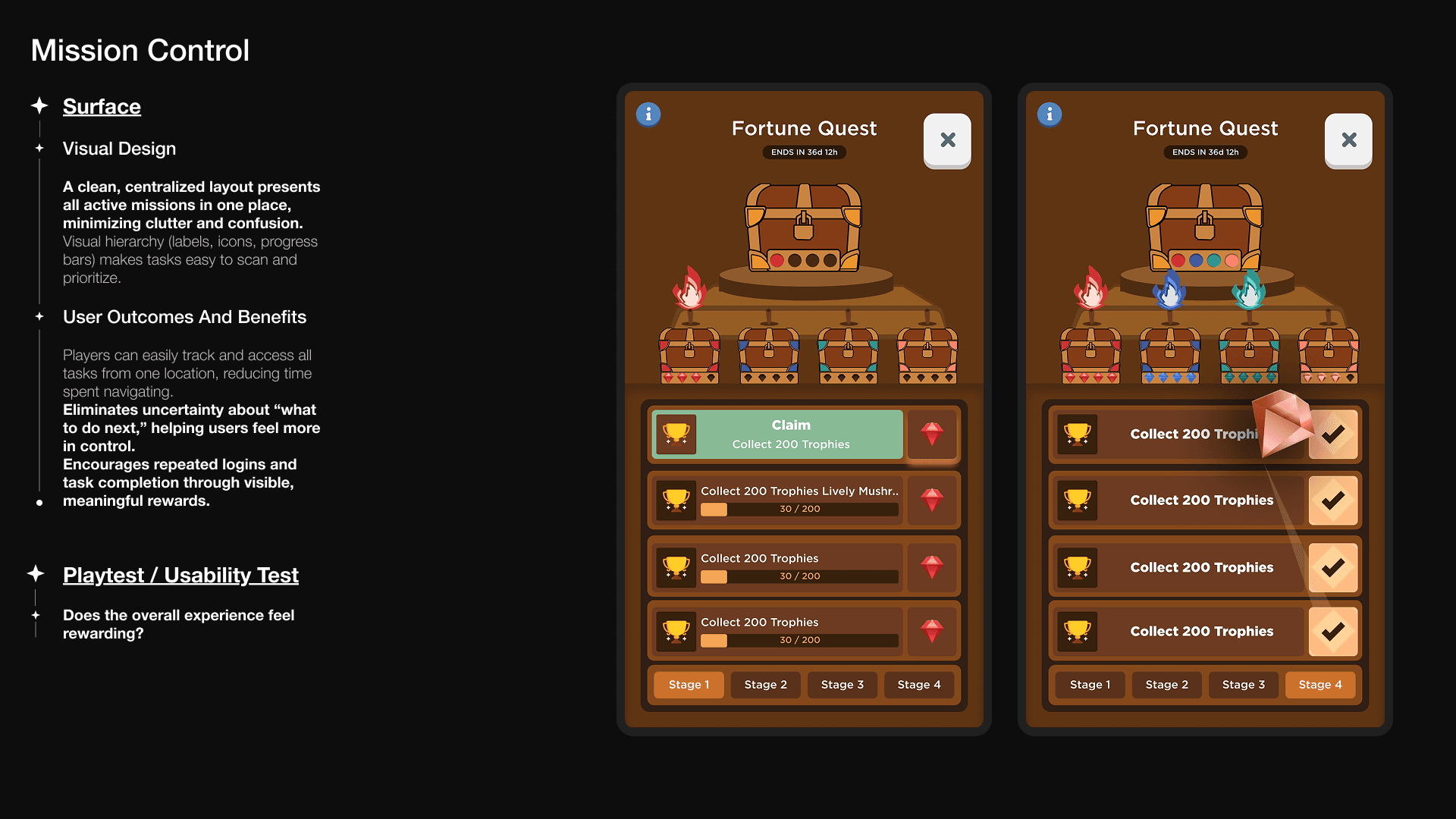
03 Mission Control
04 Cannon Carnival
Learnings, Challenges and Potential Impact
Learnings:
UX as Monetization Strategy:
The project deepened my understanding of how thoughtful UX design can directly drive both player engagement and sustainable monetization in a live game environment. Integrating monetization does not have to compromise player trust; instead, well-designed, data-driven features can create value for both players and the business.
Power of Player-Centric Design:
Regular user interviews, playtests, and analytics helped me empathize with diverse player motivations and pain points. This iterative process reinforced the importance of involving users early and often—leading to solutions that are both innovative and genuinely enjoyable.Systemic & Modular Thinking:
Working across multiple major features (Champion’s Peak, Profile, Mission Control, Cannon Fest), I honed the ability to break down complex systems into modular, testable components. This approach enabled rapid iteration and easier collaboration with cross-functional teams.Data-Driven Iteration:
Deploying features in live, soft-launch environments taught me how small design changes—like the placement of a leaderboard or the feedback in a reward animation—can have measurable impacts on ARPU, retention, and daily active usage.
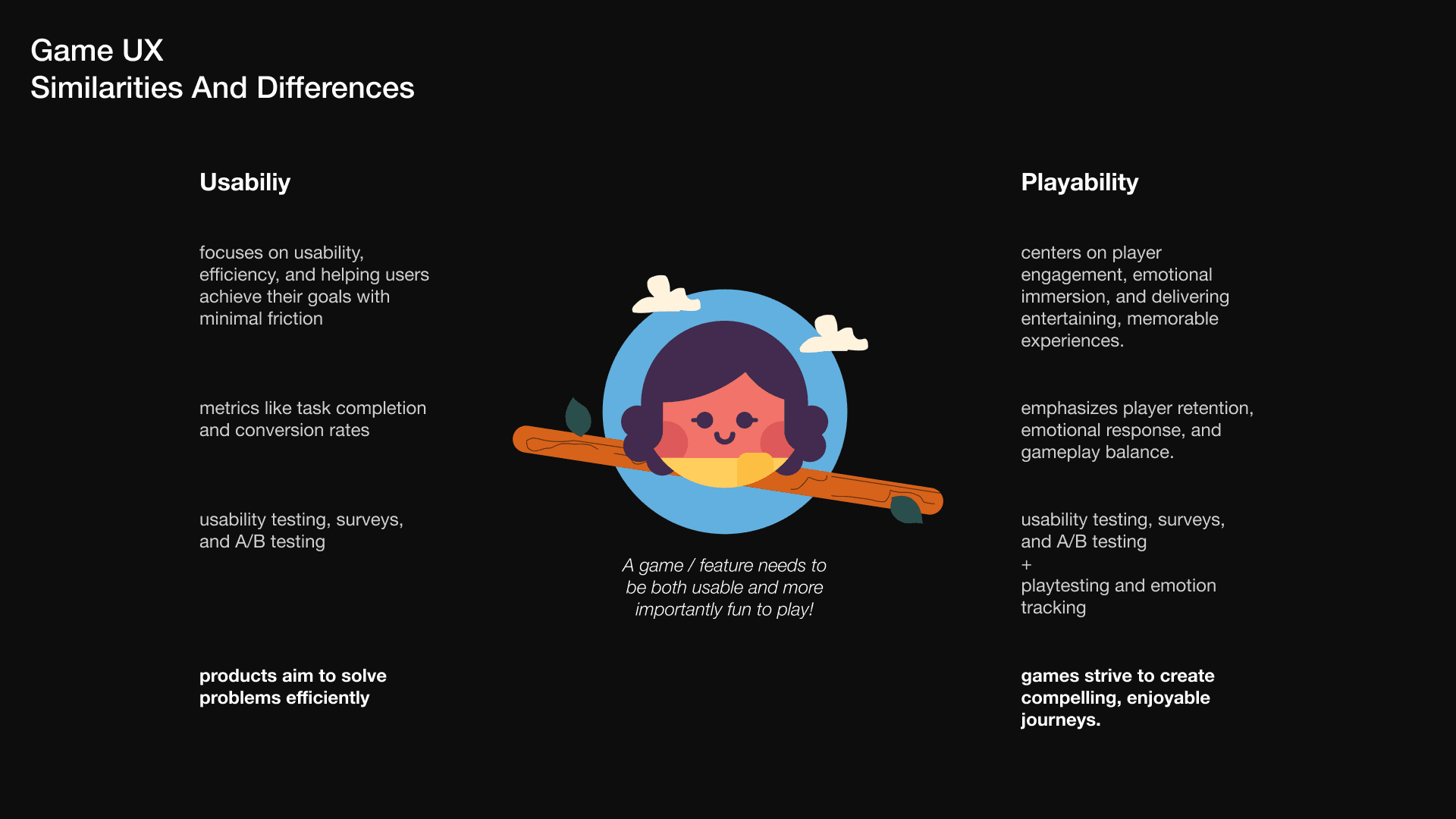
Game UX: Similarities and Differences
Challenges:
Balancing Business and Player Needs:
One of the toughest challenges was designing monetization tactics that enhanced, rather than disrupted, the core user experience. Finding this balance required extensive A/B testing, continuous stakeholder alignment, and vigilance to avoid exploits or player fatigue.
Maintaining Clarity at Scale:
As features multiplied, keeping the interface simple, intuitive, and visually unambiguous became a key hurdle—especially with limited mobile real estate and cognitively diverse users.Adapting in a Fast-Moving Environment:
Working within Zynga’s rapid, live-ops-driven development cycles required adaptability and clear communication. Priorities and KPIs often shifted, making it crucial to document design rationale and maintain flexibility in both strategy and execution.Cross-Team Coordination:
Translating design intent into live production involved close coordination with product managers, engineers, and analytics teams. Ensuring alignment and quick feedback loops was critical to prevent delays and achieve a unified product vision.
Impact:
Quantitative Business Impact:
The Champion’s Peak feature, for example, delivered a 6.3% increase in ARPU among top-tier players post-launch. Dashboard and event upgrades improved player retention and engagement, with test cohorts reporting higher daily usage and session length.
Quality of Player Experience:
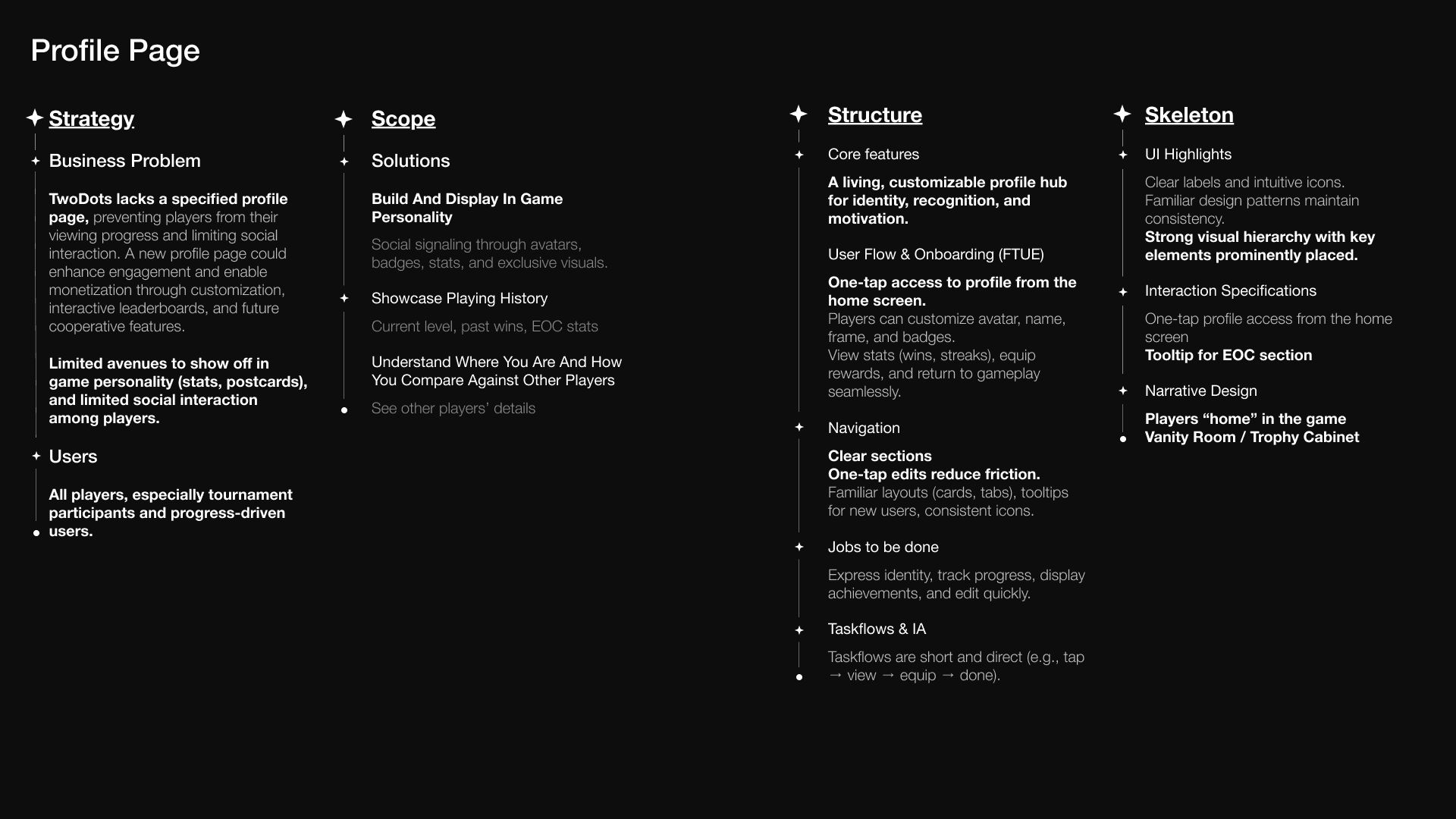
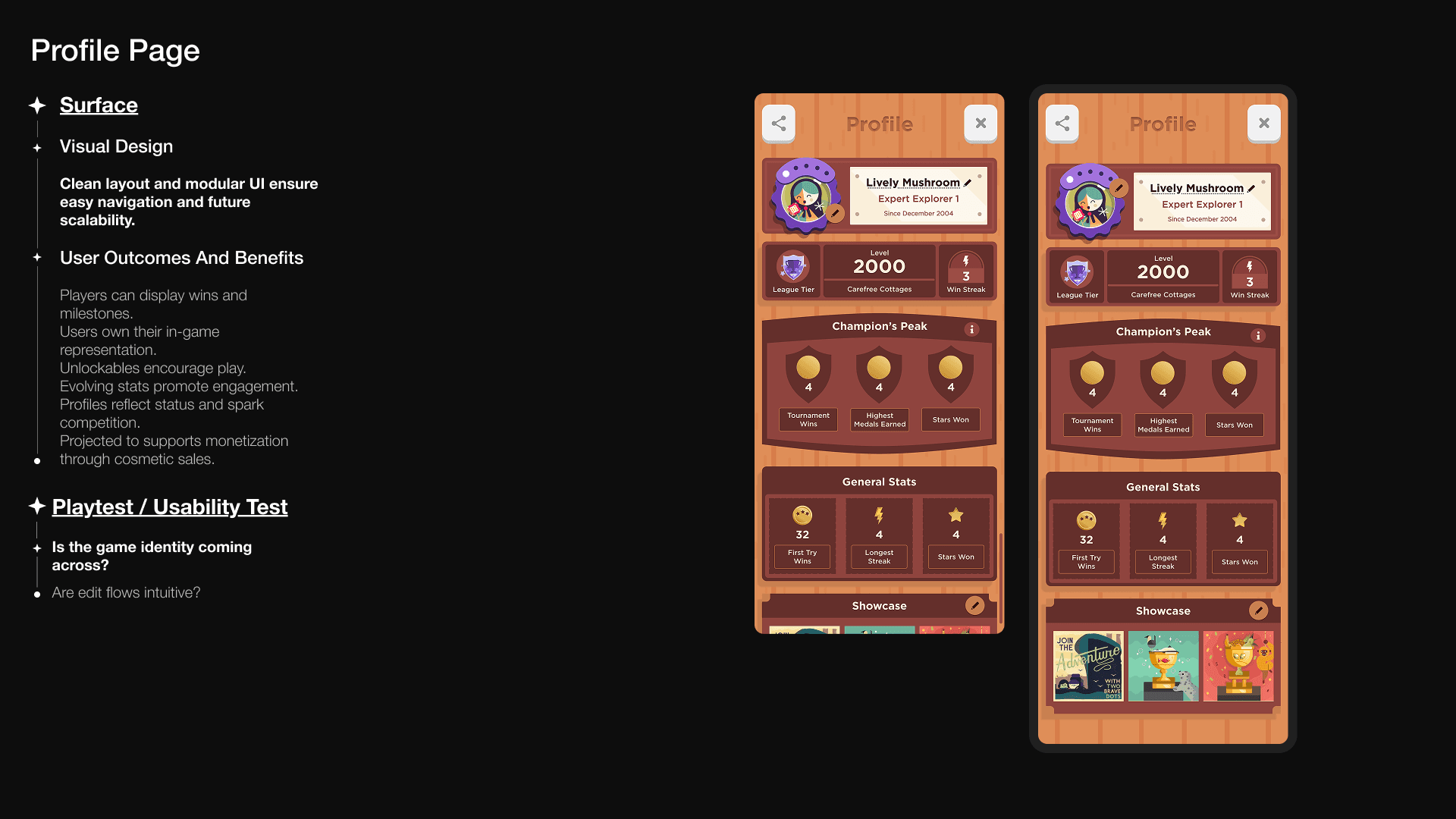
Players reported greater satisfaction, a stronger sense of achievement, and improved clarity around both goals and rewards. Customization features (like the revamped profile) fostered a sense of ownership and identity—key to long-term loyalty.Scalable Design Methodology:
The project validated a modular, user-centered methodology that can be replicated across live games. By integrating design thinking, real-world metrics, and agile delivery, the team was able to craft features that are easy to iterate and robust to future content expansions.
Reflections
What Worked
Player-Centric Feature Design:
Placing player needs, motivations, and behaviors at the core ensured features like Champion’s Peak and Profile Page felt valuable and engaging, rather than intrusive. User interviews and empathy maps directly shaped solutions that aligned with real pain points and aspirations.
Iterative, Data-Driven Process:
Rapid prototyping and A/B testing in live environments enabled continuous improvement and agility. Real-time analytics and feedback from soft launches guided quick updates and refinements, resulting in sharper, more effective features.Cross-Functional Collaboration:
Close collaboration between UX, product, engineering, and analytics teams promoted holistic solutions and reduced miscommunication. This alignment helped achieve both player and business goals efficiently.Modular, Scalable Systems:
By building features to be modular (e.g., Profile customization, mission dashboards), the team created solutions that could adapt easily to future content and business needs, supporting ongoing innovation beyond the initial release.
Additionally, while great effort was put into tailoring features for different player segments, not every new mechanic resonated equally with all users. Some aspects of messaging, onboarding, and targeting could have been refined further to ensure each player group clearly understood the benefits and how to participate. Striking the right balance between introducing monetization and preserving player trust required continual adjustment and sensitivity to player feedback.
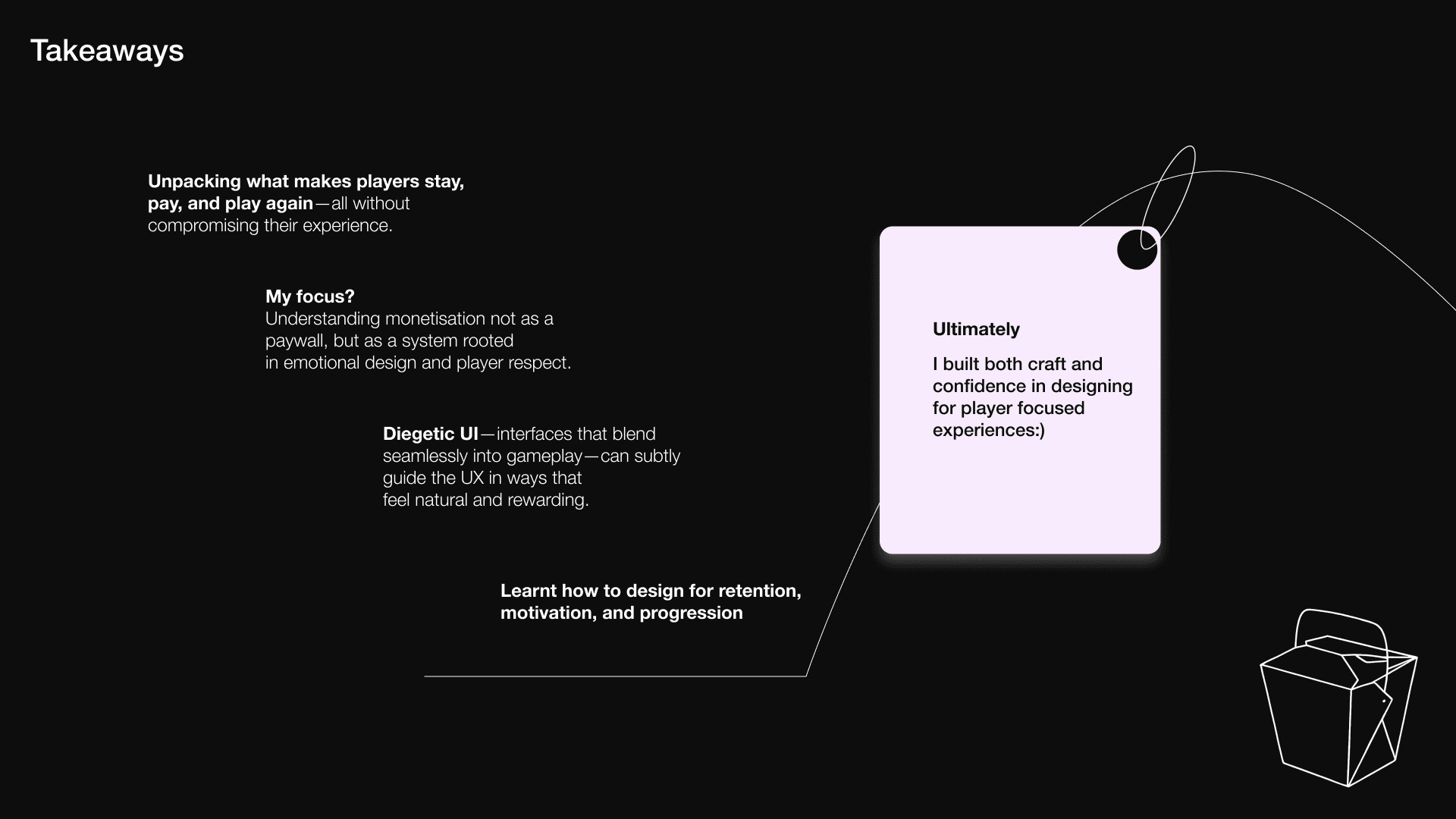
This experience significantly advanced my skills in user research, cross-functional teamwork, data analytics, and strategic communication—providing a solid foundation for designing impactful, business-ready solutions in any interactive digital product environment.
TwoDots
Designing for monetization while balancing player
engagement for a sustainable experience in mobile games.
*This project is under NDA and has be adapted to be showcased as this study.
Team
Core Pre - Prod Team (4) People
1 PM, 1 Game Designer, 1 Artist and me as the UX Designer
Functions: Total 8;
Product, Game Design, Producer, QA / Tester, Software
Engineering, Art, Tech Art/ Animation and UX Design
Pod structure, meaning close collaboration with all functions.
Type
Internship
Duration
6 Months
My Role
Sole UX Designer in India pod for a live mobile game, managing end-to-end design in collaboration with global teams and stakeholders.
Shipped four high-impact features, such as the game’s first End of Content (+6.3% gold spend), a Profile system upgrade, and two Live Ops features (+5.5% IAP + Ad ARPU).
Delivered revenue-driving features by strategically aligning player needs, business goals, and global collaboration, optimizing for engagement, retention, and growth.
Introduction
In the highly competitive mobile gaming sector, monetization is vital for business sustainability, yet aggressively implemented strategies risk alienating players and harming long-term retention. Games like TwoDots, with a loyal, casual player base and over 100 million downloads, must find an ethical, enjoyable balance between generating revenue and preserving player satisfaction.
My internship with Zynga challenged me to design player-first features that foster engagement and enable monetization without diminishing the calming, rewarding core of TwoDots.
Problem Statement
The mission was grand but clear: "How might we design for monetization while balancing player engagement to ensure a rewarding and sustainable experience?"
Background: Zynga and Match 3 Games
Zynga, a name synonymous with titles like FarmVille and Words With Friends, has focused its efforts on live, data-driven games. The company’s vision: "connecting the world through games."
TwoDots, a stylish, minimalist game, stood out in Zynga's portfolio for its calming design, deep challenge, and thriving global community.
As I joined the team, I met not just code and pixels, but a family of developers, artists, and strategists—united in the pursuit of fun and sustainable engagement.
The domain behind Match-3 games was rich and storied—dating back to Tetris, refined by Bejeweled, and revolutionized by Candy Crush. These games thrived on progressive challenges, reward loops, and ever-evolving feature sets. But in this competitive space,
standing out meant more than a clever game mechanic—it required empathy and innovation.
I began by observing engagement hooks: community leaderboards, daily challenges, calming design, and especially the psychological pull of progression. Monetization models ranged from gentle nudges to bold offers—always a careful dance between business needs and player trust.
Ways of Working
The India pod comprised of 24 people spread across 8 functions: Product, Game Design, UX, Art, Tech Art / Animation, Dev and Producer
A super short explainer of the design process
Zynga's approach to games + Influence on chosen design methodology
In short:
TwoDots
User and Game Persona
Business of Games
In short:
Why do games create new features / events?
Features I Worked On
01 Champion's Peak
02 Profile Page
03 Mission Control
04 Cannon Fest
01 Champion's Peak
02 Profile Page
03 Mission Control
04 Cannon Carnival
Learnings, Challenges and Potential Impact
Learnings:
UX as Monetization Strategy:
The project deepened my understanding of how thoughtful UX design can directly drive both player engagement and sustainable monetization in a live game environment. Integrating monetization does not have to compromise player trust; instead, well-designed, data-driven features can create value for both players and the business.
Power of Player-Centric Design:
Regular user interviews, playtests, and analytics helped me empathize with diverse player motivations and pain points. This iterative process reinforced the importance of involving users early and often—leading to solutions that are both innovative and genuinely enjoyable.Systemic & Modular Thinking:
Working across multiple major features (Champion’s Peak, Profile, Mission Control, Cannon Fest), I honed the ability to break down complex systems into modular, testable components. This approach enabled rapid iteration and easier collaboration with cross-functional teams.Data-Driven Iteration:
Deploying features in live, soft-launch environments taught me how small design changes—like the placement of a leaderboard or the feedback in a reward animation—can have measurable impacts on ARPU, retention, and daily active usage.
Game UX: Similarities and Differences
Challenges:
Balancing Business and Player Needs:
One of the toughest challenges was designing monetization tactics that enhanced, rather than disrupted, the core user experience. Finding this balance required extensive A/B testing, continuous stakeholder alignment, and vigilance to avoid exploits or player fatigue.
Maintaining Clarity at Scale:
As features multiplied, keeping the interface simple, intuitive, and visually unambiguous became a key hurdle—especially with limited mobile real estate and cognitively diverse users.Adapting in a Fast-Moving Environment:
Working within Zynga’s rapid, live-ops-driven development cycles required adaptability and clear communication. Priorities and KPIs often shifted, making it crucial to document design rationale and maintain flexibility in both strategy and execution.Cross-Team Coordination:
Translating design intent into live production involved close coordination with product managers, engineers, and analytics teams. Ensuring alignment and quick feedback loops was critical to prevent delays and achieve a unified product vision.
Impact:
Quantitative Business Impact:
The Champion’s Peak feature, for example, delivered a 6.3% increase in ARPU among top-tier players post-launch. Dashboard and event upgrades improved player retention and engagement, with test cohorts reporting higher daily usage and session length.
Quality of Player Experience:
Players reported greater satisfaction, a stronger sense of achievement, and improved clarity around both goals and rewards. Customization features (like the revamped profile) fostered a sense of ownership and identity—key to long-term loyalty.Scalable Design Methodology:
The project validated a modular, user-centered methodology that can be replicated across live games. By integrating design thinking, real-world metrics, and agile delivery, the team was able to craft features that are easy to iterate and robust to future content expansions.
Reflections
What Worked
Player-Centric Feature Design:
Placing player needs, motivations, and behaviors at the core ensured features like Champion’s Peak and Profile Page felt valuable and engaging, rather than intrusive. User interviews and empathy maps directly shaped solutions that aligned with real pain points and aspirations.
Iterative, Data-Driven Process:
Rapid prototyping and A/B testing in live environments enabled continuous improvement and agility. Real-time analytics and feedback from soft launches guided quick updates and refinements, resulting in sharper, more effective features.Cross-Functional Collaboration:
Close collaboration between UX, product, engineering, and analytics teams promoted holistic solutions and reduced miscommunication. This alignment helped achieve both player and business goals efficiently.Modular, Scalable Systems:
By building features to be modular (e.g., Profile customization, mission dashboards), the team created solutions that could adapt easily to future content and business needs, supporting ongoing innovation beyond the initial release.
Additionally, while great effort was put into tailoring features for different player segments, not every new mechanic resonated equally with all users. Some aspects of messaging, onboarding, and targeting could have been refined further to ensure each player group clearly understood the benefits and how to participate. Striking the right balance between introducing monetization and preserving player trust required continual adjustment and sensitivity to player feedback.
This experience significantly advanced my skills in user research, cross-functional teamwork, data analytics, and strategic communication—providing a solid foundation for designing impactful, business-ready solutions in any interactive digital product environment.
TwoDots
Designing for monetization while balancing player
engagement for a sustainable experience in mobile games.
*This project is under NDA and has be adapted to be showcased as this study.
Team
Core Pre - Prod Team (4) People
1 PM, 1 Game Designer, 1 Artist and me as the UX Designer
Functions: Total 8;
Product, Game Design, Producer, QA / Tester, Software
Engineering, Art, Tech Art/ Animation and UX Design
Pod structure, meaning close collaboration with all functions.
Type
Internship
Duration
6 Months
My Role
Sole UX Designer in India pod for a live mobile game, managing end-to-end design in collaboration with global teams and stakeholders.
Shipped four high-impact features, such as the game’s first End of Content (+6.3% gold spend), a Profile system upgrade, and two Live Ops features (+5.5% IAP + Ad ARPU).
Delivered revenue-driving features by strategically aligning player needs, business goals, and global collaboration, optimizing for engagement, retention, and growth.
Introduction
In the highly competitive mobile gaming sector, monetization is vital for business sustainability, yet aggressively implemented strategies risk alienating players and harming long-term retention. Games like TwoDots, with a loyal, casual player base and over 100 million downloads, must find an ethical, enjoyable balance between generating revenue and preserving player satisfaction.
My internship with Zynga challenged me to design player-first features that foster engagement and enable monetization without diminishing the calming, rewarding core of TwoDots.
Problem Statement
The mission was grand but clear: "How might we design for monetization while balancing player engagement to ensure a rewarding and sustainable experience?"
Background: Zynga and Match 3 Games
Zynga, a name synonymous with titles like FarmVille and Words With Friends, has focused its efforts on live, data-driven games. The company’s vision: "connecting the world through games."
TwoDots, a stylish, minimalist game, stood out in Zynga's portfolio for its calming design, deep challenge, and thriving global community.
As I joined the team, I met not just code and pixels, but a family of developers, artists, and strategists—united in the pursuit of fun and sustainable engagement.
The domain behind Match-3 games was rich and storied—dating back to Tetris, refined by Bejeweled, and revolutionized by Candy Crush. These games thrived on progressive challenges, reward loops, and ever-evolving feature sets. But in this competitive space,
standing out meant more than a clever game mechanic—it required empathy and innovation.
I began by observing engagement hooks: community leaderboards, daily challenges, calming design, and especially the psychological pull of progression. Monetization models ranged from gentle nudges to bold offers—always a careful dance between business needs and player trust.
Ways of Working
The India pod comprised of 24 people spread across 8 functions: Product, Game Design, UX, Art, Tech Art / Animation, Dev and Producer
A super short explainer of the design process
Zynga's approach to games + Influence on chosen design methodology
In short:
TwoDots
User and Game Persona
Business of Games
In short:
Why do games create new features / events?
Features I Worked On
01 Champion's Peak
02 Profile Page
03 Mission Control
04 Cannon Fest
01 Champion's Peak
02 Profile Page
03 Mission Control
04 Cannon Carnival
Learnings, Challenges and Potential Impact
Learnings:
UX as Monetization Strategy:
The project deepened my understanding of how thoughtful UX design can directly drive both player engagement and sustainable monetization in a live game environment. Integrating monetization does not have to compromise player trust; instead, well-designed, data-driven features can create value for both players and the business.
Power of Player-Centric Design:
Regular user interviews, playtests, and analytics helped me empathize with diverse player motivations and pain points. This iterative process reinforced the importance of involving users early and often—leading to solutions that are both innovative and genuinely enjoyable.Systemic & Modular Thinking:
Working across multiple major features (Champion’s Peak, Profile, Mission Control, Cannon Fest), I honed the ability to break down complex systems into modular, testable components. This approach enabled rapid iteration and easier collaboration with cross-functional teams.Data-Driven Iteration:
Deploying features in live, soft-launch environments taught me how small design changes—like the placement of a leaderboard or the feedback in a reward animation—can have measurable impacts on ARPU, retention, and daily active usage.
Game UX: Similarities and Differences
Challenges:
Balancing Business and Player Needs:
One of the toughest challenges was designing monetization tactics that enhanced, rather than disrupted, the core user experience. Finding this balance required extensive A/B testing, continuous stakeholder alignment, and vigilance to avoid exploits or player fatigue.
Maintaining Clarity at Scale:
As features multiplied, keeping the interface simple, intuitive, and visually unambiguous became a key hurdle—especially with limited mobile real estate and cognitively diverse users.Adapting in a Fast-Moving Environment:
Working within Zynga’s rapid, live-ops-driven development cycles required adaptability and clear communication. Priorities and KPIs often shifted, making it crucial to document design rationale and maintain flexibility in both strategy and execution.Cross-Team Coordination:
Translating design intent into live production involved close coordination with product managers, engineers, and analytics teams. Ensuring alignment and quick feedback loops was critical to prevent delays and achieve a unified product vision.
Impact:
Quantitative Business Impact:
The Champion’s Peak feature, for example, delivered a 6.3% increase in ARPU among top-tier players post-launch. Dashboard and event upgrades improved player retention and engagement, with test cohorts reporting higher daily usage and session length.
Quality of Player Experience:
Players reported greater satisfaction, a stronger sense of achievement, and improved clarity around both goals and rewards. Customization features (like the revamped profile) fostered a sense of ownership and identity—key to long-term loyalty.Scalable Design Methodology:
The project validated a modular, user-centered methodology that can be replicated across live games. By integrating design thinking, real-world metrics, and agile delivery, the team was able to craft features that are easy to iterate and robust to future content expansions.
Reflections
What Worked
Player-Centric Feature Design:
Placing player needs, motivations, and behaviors at the core ensured features like Champion’s Peak and Profile Page felt valuable and engaging, rather than intrusive. User interviews and empathy maps directly shaped solutions that aligned with real pain points and aspirations.
Iterative, Data-Driven Process:
Rapid prototyping and A/B testing in live environments enabled continuous improvement and agility. Real-time analytics and feedback from soft launches guided quick updates and refinements, resulting in sharper, more effective features.Cross-Functional Collaboration:
Close collaboration between UX, product, engineering, and analytics teams promoted holistic solutions and reduced miscommunication. This alignment helped achieve both player and business goals efficiently.Modular, Scalable Systems:
By building features to be modular (e.g., Profile customization, mission dashboards), the team created solutions that could adapt easily to future content and business needs, supporting ongoing innovation beyond the initial release.
Additionally, while great effort was put into tailoring features for different player segments, not every new mechanic resonated equally with all users. Some aspects of messaging, onboarding, and targeting could have been refined further to ensure each player group clearly understood the benefits and how to participate. Striking the right balance between introducing monetization and preserving player trust required continual adjustment and sensitivity to player feedback.
This experience significantly advanced my skills in user research, cross-functional teamwork, data analytics, and strategic communication—providing a solid foundation for designing impactful, business-ready solutions in any interactive digital product environment.
TwoDots
Designing for monetization while balancing player
engagement for a sustainable experience in mobile games.
*This project is under NDA and has be adapted to be showcased as this study.
Team
Core Pre - Prod Team (4) People
1 PM, 1 Game Designer, 1 Artist and me as the UX Designer
Functions: Total 8;
Product, Game Design, Producer, QA / Tester, Software
Engineering, Art, Tech Art/ Animation and UX Design
Pod structure, meaning close collaboration with all functions.
Type
Internship
Duration
6 Months
My Role
Sole UX Designer in India pod for a live mobile game, managing end-to-end design in collaboration with global teams and stakeholders.
Shipped four high-impact features, such as the game’s first End of Content (+6.3% gold spend), a Profile system upgrade, and two Live Ops features (+5.5% IAP + Ad ARPU).
Delivered revenue-driving features by strategically aligning player needs, business goals, and global collaboration, optimizing for engagement, retention, and growth.
Introduction
In the highly competitive mobile gaming sector, monetization is vital for business sustainability, yet aggressively implemented strategies risk alienating players and harming long-term retention. Games like TwoDots, with a loyal, casual player base and over 100 million downloads, must find an ethical, enjoyable balance between generating revenue and preserving player satisfaction.
My internship with Zynga challenged me to design player-first features that foster engagement and enable monetization without diminishing the calming, rewarding core of TwoDots.
Problem Statement
The mission was grand but clear: "How might we design for monetization while balancing player engagement to ensure a rewarding and sustainable experience?"
Background: Zynga and Match 3 Games
Zynga, a name synonymous with titles like FarmVille and Words With Friends, has focused its efforts on live, data-driven games. The company’s vision: "connecting the world through games."
TwoDots, a stylish, minimalist game, stood out in Zynga's portfolio for its calming design, deep challenge, and thriving global community.
As I joined the team, I met not just code and pixels, but a family of developers, artists, and strategists—united in the pursuit of fun and sustainable engagement.
The domain behind Match-3 games was rich and storied—dating back to Tetris, refined by Bejeweled, and revolutionized by Candy Crush. These games thrived on progressive challenges, reward loops, and ever-evolving feature sets. But in this competitive space,
standing out meant more than a clever game mechanic—it required empathy and innovation.
I began by observing engagement hooks: community leaderboards, daily challenges, calming design, and especially the psychological pull of progression. Monetization models ranged from gentle nudges to bold offers—always a careful dance between business needs and player trust.
Ways of Working
The India pod comprised of 24 people spread across 8 functions: Product, Game Design, UX, Art, Tech Art / Animation, Dev and Producer
A super short explainer of the design process
Zynga's approach to games + Influence on chosen design methodology
In short:
TwoDots
User and Game Persona
Business of Games
In short:
Why do games create new features / events?
Features I Worked On
01 Champion's Peak
02 Profile Page
03 Mission Control
04 Cannon Fest
01 Champion's Peak
02 Profile Page
03 Mission Control
04 Cannon Carnival
Learnings, Challenges and Potential Impact
Learnings:
UX as Monetization Strategy:
The project deepened my understanding of how thoughtful UX design can directly drive both player engagement and sustainable monetization in a live game environment. Integrating monetization does not have to compromise player trust; instead, well-designed, data-driven features can create value for both players and the business.
Power of Player-Centric Design:
Regular user interviews, playtests, and analytics helped me empathize with diverse player motivations and pain points. This iterative process reinforced the importance of involving users early and often—leading to solutions that are both innovative and genuinely enjoyable.Systemic & Modular Thinking:
Working across multiple major features (Champion’s Peak, Profile, Mission Control, Cannon Fest), I honed the ability to break down complex systems into modular, testable components. This approach enabled rapid iteration and easier collaboration with cross-functional teams.Data-Driven Iteration:
Deploying features in live, soft-launch environments taught me how small design changes—like the placement of a leaderboard or the feedback in a reward animation—can have measurable impacts on ARPU, retention, and daily active usage.
Game UX: Similarities and Differences
Challenges:
Balancing Business and Player Needs:
One of the toughest challenges was designing monetization tactics that enhanced, rather than disrupted, the core user experience. Finding this balance required extensive A/B testing, continuous stakeholder alignment, and vigilance to avoid exploits or player fatigue.
Maintaining Clarity at Scale:
As features multiplied, keeping the interface simple, intuitive, and visually unambiguous became a key hurdle—especially with limited mobile real estate and cognitively diverse users.Adapting in a Fast-Moving Environment:
Working within Zynga’s rapid, live-ops-driven development cycles required adaptability and clear communication. Priorities and KPIs often shifted, making it crucial to document design rationale and maintain flexibility in both strategy and execution.Cross-Team Coordination:
Translating design intent into live production involved close coordination with product managers, engineers, and analytics teams. Ensuring alignment and quick feedback loops was critical to prevent delays and achieve a unified product vision.
Impact:
Quantitative Business Impact:
The Champion’s Peak feature, for example, delivered a 6.3% increase in ARPU among top-tier players post-launch. Dashboard and event upgrades improved player retention and engagement, with test cohorts reporting higher daily usage and session length.
Quality of Player Experience:
Players reported greater satisfaction, a stronger sense of achievement, and improved clarity around both goals and rewards. Customization features (like the revamped profile) fostered a sense of ownership and identity—key to long-term loyalty.Scalable Design Methodology:
The project validated a modular, user-centered methodology that can be replicated across live games. By integrating design thinking, real-world metrics, and agile delivery, the team was able to craft features that are easy to iterate and robust to future content expansions.
Reflections
What Worked
Player-Centric Feature Design:
Placing player needs, motivations, and behaviors at the core ensured features like Champion’s Peak and Profile Page felt valuable and engaging, rather than intrusive. User interviews and empathy maps directly shaped solutions that aligned with real pain points and aspirations.
Iterative, Data-Driven Process:
Rapid prototyping and A/B testing in live environments enabled continuous improvement and agility. Real-time analytics and feedback from soft launches guided quick updates and refinements, resulting in sharper, more effective features.Cross-Functional Collaboration:
Close collaboration between UX, product, engineering, and analytics teams promoted holistic solutions and reduced miscommunication. This alignment helped achieve both player and business goals efficiently.Modular, Scalable Systems:
By building features to be modular (e.g., Profile customization, mission dashboards), the team created solutions that could adapt easily to future content and business needs, supporting ongoing innovation beyond the initial release.
Additionally, while great effort was put into tailoring features for different player segments, not every new mechanic resonated equally with all users. Some aspects of messaging, onboarding, and targeting could have been refined further to ensure each player group clearly understood the benefits and how to participate. Striking the right balance between introducing monetization and preserving player trust required continual adjustment and sensitivity to player feedback.
This experience significantly advanced my skills in user research, cross-functional teamwork, data analytics, and strategic communication—providing a solid foundation for designing impactful, business-ready solutions in any interactive digital product environment.
TwoDots
Designing for monetization while balancing player
engagement for a sustainable experience
in mobile games.
*This project is under NDA and has be adapted to be showcased as this study.
Team
Core Pre - Prod Team (4) People
1 PM, 1 Game Designer, 1 Artist and me as the UX Designer
Functions: Total 8;
Product, Game Design, Producer, QA / Tester, Software
Engineering, Art, Tech Art/ Animation and UX Design
Pod structure, meaning close collaboration with all functions.
Type
Internship
Duration
6 Months
My Role
Sole UX Designer in India pod for a live mobile game, managing end-to-end design in collaboration with global teams and stakeholders.
Shipped four high-impact features, such as the game’s first End of Content (+6.3% gold spend), a Profile system upgrade, and two Live Ops features (+5.5% IAP + Ad ARPU).
Delivered revenue-driving features by strategically aligning player needs, business goals, and global collaboration, optimizing for engagement, retention, and growth.
Introduction
In the highly competitive mobile gaming sector, monetization is vital for business sustainability, yet aggressively implemented strategies risk alienating players and harming long-term retention. Games like TwoDots, with a loyal, casual player base and over 100 million downloads, must find an ethical, enjoyable balance between generating revenue and preserving player satisfaction.
My internship with Zynga challenged me to design player-first features that foster engagement and enable monetization without diminishing the calming, rewarding core of TwoDots.
Problem Statement
The mission was grand but clear: "How might we design for monetization while balancing player engagement to ensure a rewarding and sustainable experience?"
Background: Zynga and Match 3 Games
Zynga, a name synonymous with titles like FarmVille and Words With Friends, has focused its efforts on live, data-driven games. The company’s vision: "connecting the world through games."
TwoDots, a stylish, minimalist game, stood out in Zynga's portfolio for its calming design, deep challenge, and thriving global community.
As I joined the team, I met not just code and pixels, but a family of developers, artists, and strategists—united in the pursuit of fun and sustainable engagement.
The domain behind Match-3 games was rich and storied—dating back to Tetris, refined by Bejeweled, and revolutionized by Candy Crush. These games thrived on progressive challenges, reward loops, and ever-evolving feature sets. But in this competitive space,
standing out meant more than a clever game mechanic—it required empathy and innovation.
I began by observing engagement hooks: community leaderboards, daily challenges, calming design, and especially the psychological pull of progression. Monetization models ranged from gentle nudges to bold offers—always a careful dance between business needs and player trust.
Ways of Working
The India pod comprised of 24 people spread across 8 functions: Product, Game Design, UX, Art, Tech Art / Animation, Dev and Producer
A super short explainer of the design process
Zynga's approach to games + Influence on chosen design methodology
In short:
TwoDots
User and Game Persona
Business of Games
In short:
Why do games create new features / events?
Features I Worked On
01 Champion's Peak
02 Profile Page
03 Mission Control
04 Cannon Fest
01 Champion's Peak
02 Profile Page
03 Mission Control
04 Cannon Carnival
Learnings, Challenges and Potential Impact
Learnings:
UX as Monetization Strategy:
The project deepened my understanding of how thoughtful UX design can directly drive both player engagement and sustainable monetization in a live game environment. Integrating monetization does not have to compromise player trust; instead, well-designed, data-driven features can create value for both players and the business.
Power of Player-Centric Design:
Regular user interviews, playtests, and analytics helped me empathize with diverse player motivations and pain points. This iterative process reinforced the importance of involving users early and often—leading to solutions that are both innovative and genuinely enjoyable.Systemic & Modular Thinking:
Working across multiple major features (Champion’s Peak, Profile, Mission Control, Cannon Fest), I honed the ability to break down complex systems into modular, testable components. This approach enabled rapid iteration and easier collaboration with cross-functional teams.Data-Driven Iteration:
Deploying features in live, soft-launch environments taught me how small design changes—like the placement of a leaderboard or the feedback in a reward animation—can have measurable impacts on ARPU, retention, and daily active usage.
Game UX: Similarities and Differences
Challenges:
Balancing Business and Player Needs:
One of the toughest challenges was designing monetization tactics that enhanced, rather than disrupted, the core user experience. Finding this balance required extensive A/B testing, continuous stakeholder alignment, and vigilance to avoid exploits or player fatigue.
Maintaining Clarity at Scale:
As features multiplied, keeping the interface simple, intuitive, and visually unambiguous became a key hurdle—especially with limited mobile real estate and cognitively diverse users.Adapting in a Fast-Moving Environment:
Working within Zynga’s rapid, live-ops-driven development cycles required adaptability and clear communication. Priorities and KPIs often shifted, making it crucial to document design rationale and maintain flexibility in both strategy and execution.Cross-Team Coordination:
Translating design intent into live production involved close coordination with product managers, engineers, and analytics teams. Ensuring alignment and quick feedback loops was critical to prevent delays and achieve a unified product vision.
Impact:
Quantitative Business Impact:
The Champion’s Peak feature, for example, delivered a 6.3% increase in ARPU among top-tier players post-launch. Dashboard and event upgrades improved player retention and engagement, with test cohorts reporting higher daily usage and session length.
Quality of Player Experience:
Players reported greater satisfaction, a stronger sense of achievement, and improved clarity around both goals and rewards. Customization features (like the revamped profile) fostered a sense of ownership and identity—key to long-term loyalty.Scalable Design Methodology:
The project validated a modular, user-centered methodology that can be replicated across live games. By integrating design thinking, real-world metrics, and agile delivery, the team was able to craft features that are easy to iterate and robust to future content expansions.
Reflections
What Worked
Player-Centric Feature Design:
Placing player needs, motivations, and behaviors at the core ensured features like Champion’s Peak and Profile Page felt valuable and engaging, rather than intrusive. User interviews and empathy maps directly shaped solutions that aligned with real pain points and aspirations.
Iterative, Data-Driven Process:
Rapid prototyping and A/B testing in live environments enabled continuous improvement and agility. Real-time analytics and feedback from soft launches guided quick updates and refinements, resulting in sharper, more effective features.Cross-Functional Collaboration:
Close collaboration between UX, product, engineering, and analytics teams promoted holistic solutions and reduced miscommunication. This alignment helped achieve both player and business goals efficiently.Modular, Scalable Systems:
By building features to be modular (e.g., Profile customization, mission dashboards), the team created solutions that could adapt easily to future content and business needs, supporting ongoing innovation beyond the initial release.
Additionally, while great effort was put into tailoring features for different player segments, not every new mechanic resonated equally with all users. Some aspects of messaging, onboarding, and targeting could have been refined further to ensure each player group clearly understood the benefits and how to participate. Striking the right balance between introducing monetization and preserving player trust required continual adjustment and sensitivity to player feedback.
This experience significantly advanced my skills in user research, cross-functional teamwork, data analytics, and strategic communication—providing a solid foundation for designing impactful, business-ready solutions in any interactive digital product environment.
TwoDots
Designing for monetization while balancing player engagement for a sustainable experience in mobile games.
*This project is under NDA and has be adapted to be showcased as this study.
Team
Core Pre - Prod Team (4) People
1 PM, 1 Game Designer, 1 Artist and me as the UX Designer
Functions: Total 8;
Product, Game Design, Producer, QA / Tester, Software
Engineering, Art, Tech Art/ Animation and UX Design
Pod structure, meaning close collaboration with all functions.
Type
Internship
Duration
6 Months
My Role
Sole UX Designer in India pod for a live mobile game, managing end-to-end design in collaboration with global teams and stakeholders.
Shipped four high-impact features, such as the game’s first End of Content (+6.3% gold spend), a Profile system upgrade, and two Live Ops features (+5.5% IAP + Ad ARPU).
Delivered revenue-driving features by strategically aligning player needs, business goals, and global collaboration, optimizing for engagement, retention, and growth.
Introduction
In the highly competitive mobile gaming sector, monetization is vital for business sustainability, yet aggressively implemented strategies risk alienating players and harming long-term retention. Games like TwoDots, with a loyal, casual player base and over 100 million downloads, must find an ethical, enjoyable balance between generating revenue and preserving player satisfaction.
My internship with Zynga challenged me to design player-first features that foster engagement and enable monetization without diminishing the calming, rewarding core of TwoDots.
Problem Statement
The mission was grand but clear: "How might we design for monetization while balancing player engagement to ensure a rewarding and sustainable experience?"
Background: Zynga and Match 3 Games
Zynga, a name synonymous with titles like FarmVille and Words With Friends, has focused its efforts on live, data-driven games. The company’s vision: "connecting the world through games."
TwoDots, a stylish, minimalist game, stood out in Zynga's portfolio for its calming design, deep challenge, and thriving global community.
As I joined the team, I met not just code and pixels, but a family of developers, artists, and strategists—united in the pursuit of fun and sustainable engagement.
The domain behind Match-3 games was rich and storied—dating back to Tetris, refined by Bejeweled, and revolutionized by Candy Crush. These games thrived on progressive challenges, reward loops, and ever-evolving feature sets. But in this competitive space,
standing out meant more than a clever game mechanic—it required empathy and innovation.
I began by observing engagement hooks: community leaderboards, daily challenges, calming design, and especially the psychological pull of progression. Monetization models ranged from gentle nudges to bold offers—always a careful dance between business needs and player trust.
Ways of Working
The India pod comprised of 24 people spread across 8 functions: Product, Game Design, UX, Art, Tech Art / Animation, Dev and Producer
A super short explainer of the design process
Zynga's approach to games + Influence on chosen design methodology
In short:
TwoDots
User and Game Persona
Business of Games
In short:
Why do games create new features / events?
Features I Worked On
01 Champion's Peak
02 Profile Page
03 Mission Control
04 Cannon Fest
01 Champion's Peak
02 Profile Page
03 Mission Control
04 Cannon Carnival
Learnings, Challenges and Potential Impact
Learnings:
UX as Monetization Strategy:
The project deepened my understanding of how thoughtful UX design can directly drive both player engagement and sustainable monetization in a live game environment. Integrating monetization does not have to compromise player trust; instead, well-designed, data-driven features can create value for both players and the business.
Power of Player-Centric Design:
Regular user interviews, playtests, and analytics helped me empathize with diverse player motivations and pain points. This iterative process reinforced the importance of involving users early and often—leading to solutions that are both innovative and genuinely enjoyable.Systemic & Modular Thinking:
Working across multiple major features (Champion’s Peak, Profile, Mission Control, Cannon Fest), I honed the ability to break down complex systems into modular, testable components. This approach enabled rapid iteration and easier collaboration with cross-functional teams.Data-Driven Iteration:
Deploying features in live, soft-launch environments taught me how small design changes—like the placement of a leaderboard or the feedback in a reward animation—can have measurable impacts on ARPU, retention, and daily active usage.
Game UX: Similarities and Differences
Challenges:
Balancing Business and Player Needs:
One of the toughest challenges was designing monetization tactics that enhanced, rather than disrupted, the core user experience. Finding this balance required extensive A/B testing, continuous stakeholder alignment, and vigilance to avoid exploits or player fatigue.
Maintaining Clarity at Scale:
As features multiplied, keeping the interface simple, intuitive, and visually unambiguous became a key hurdle—especially with limited mobile real estate and cognitively diverse users.Adapting in a Fast-Moving Environment:
Working within Zynga’s rapid, live-ops-driven development cycles required adaptability and clear communication. Priorities and KPIs often shifted, making it crucial to document design rationale and maintain flexibility in both strategy and execution.Cross-Team Coordination:
Translating design intent into live production involved close coordination with product managers, engineers, and analytics teams. Ensuring alignment and quick feedback loops was critical to prevent delays and achieve a unified product vision.
Impact:
Quantitative Business Impact:
The Champion’s Peak feature, for example, delivered a 6.3% increase in ARPU among top-tier players post-launch. Dashboard and event upgrades improved player retention and engagement, with test cohorts reporting higher daily usage and session length.
Quality of Player Experience:
Players reported greater satisfaction, a stronger sense of achievement, and improved clarity around both goals and rewards. Customization features (like the revamped profile) fostered a sense of ownership and identity—key to long-term loyalty.Scalable Design Methodology:
The project validated a modular, user-centered methodology that can be replicated across live games. By integrating design thinking, real-world metrics, and agile delivery, the team was able to craft features that are easy to iterate and robust to future content expansions.
Reflections
What Worked
Player-Centric Feature Design:
Placing player needs, motivations, and behaviors at the core ensured features like Champion’s Peak and Profile Page felt valuable and engaging, rather than intrusive. User interviews and empathy maps directly shaped solutions that aligned with real pain points and aspirations.
Iterative, Data-Driven Process:
Rapid prototyping and A/B testing in live environments enabled continuous improvement and agility. Real-time analytics and feedback from soft launches guided quick updates and refinements, resulting in sharper, more effective features.Cross-Functional Collaboration:
Close collaboration between UX, product, engineering, and analytics teams promoted holistic solutions and reduced miscommunication. This alignment helped achieve both player and business goals efficiently.Modular, Scalable Systems:
By building features to be modular (e.g., Profile customization, mission dashboards), the team created solutions that could adapt easily to future content and business needs, supporting ongoing innovation beyond the initial release.
Additionally, while great effort was put into tailoring features for different player segments, not every new mechanic resonated equally with all users. Some aspects of messaging, onboarding, and targeting could have been refined further to ensure each player group clearly understood the benefits and how to participate. Striking the right balance between introducing monetization and preserving player trust required continual adjustment and sensitivity to player feedback.
This experience significantly advanced my skills in user research, cross-functional teamwork, data analytics, and strategic communication—providing a solid foundation for designing impactful, business-ready solutions in any interactive digital product environment.